
LiveWire S2 Mulholland
- Battery
- 400 V10,500 Wh · unknown
- Top speed
- 159 km/h
- Range
- 193 km
- Consumption
- 54.4 Wh/kmestimated
Can You Solar Charge a LiveWire S2 Mulholland?
No DC port · Charges through its own 4400 W charger · 5500 W station
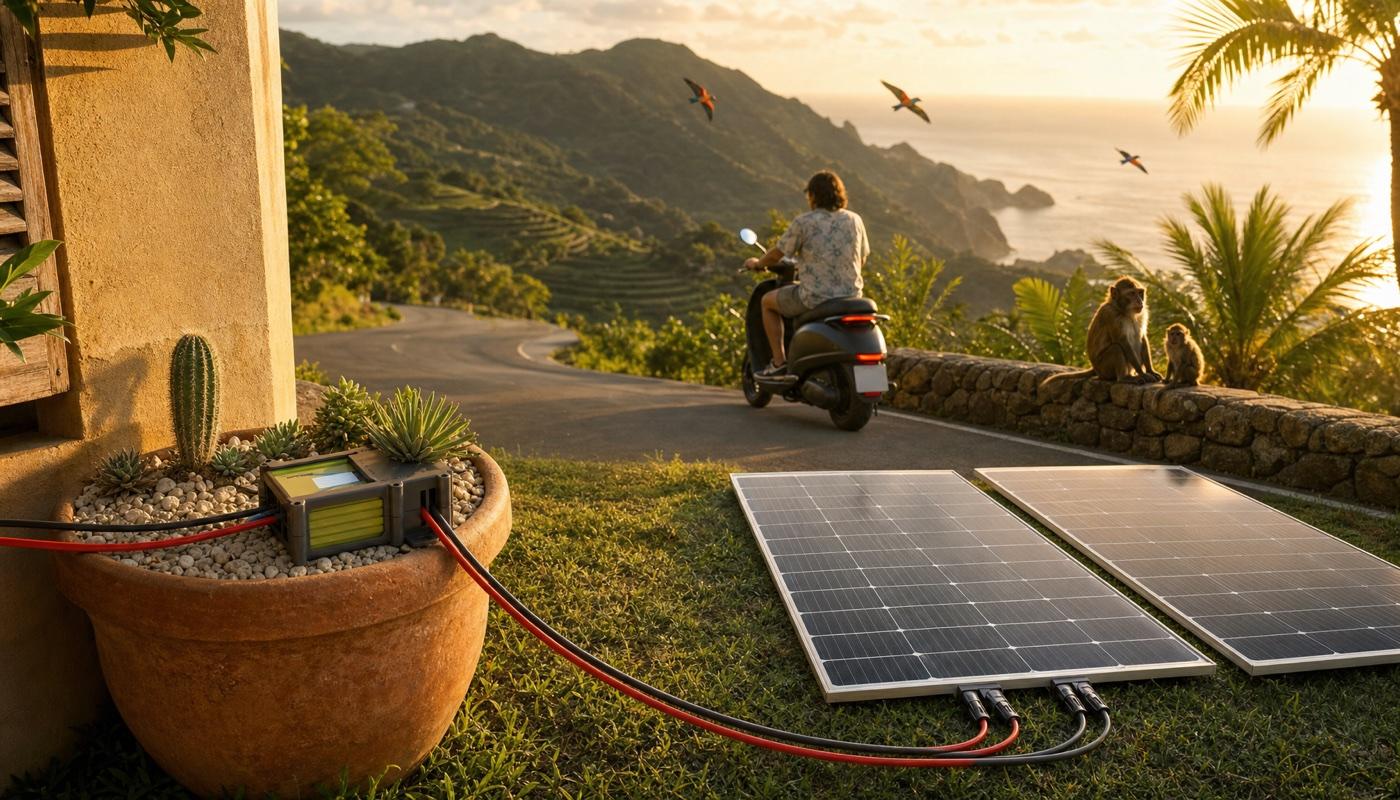
A 1200 W solar array charges a power station, and the station's AC outlet feeds the LiveWire S2 Mulholland's own charger (4400 W at 230 V) through its SAE J1772 Type 1 inlet. A 33 km day (~1795 Wh) is recovered in about 3 sun hours (3.1 sun hours/day market average). There is no separate MPPT and no charge voltage for us to recommend — the vehicle's charger owns the battery.
1200 W Solar Array
single panel
5500 W Station AC
for a 4400 W charger at 230 V
~3 hrs sun for 33 km
Daily 33 km commute recovery
Similar vehicles & kit parts
Riders also viewed


2 · Kit Cost, Payoff Period & What the Station Must Do
Should You Solar Charge Your LiveWire S2 Mulholland?
Let's consider the important factors — upfront kit cost, payback against buying gas and wall electricity, total cost of ownership, air and noise pollution, and local legal rules in United Kingdom — so you can decide for yourself.
How much does a station kit for a LiveWire S2 Mulholland cost?
A complete station kit for the LiveWire S2 Mulholland cannot be priced in this market yet, because our catalogue has no station that meets the requirement — this is not an MPPT kit: the station supplies a mains socket and the vehicle's own charger does the rest.
Will You Save Money over Gas?
The requirement is calculated — a station with at least 5500 W of AC output, 2000 Wh of capacity, and a bond route its maker supports. Our catalogue has no unit that meets it in this market yet, so we do not offer a smaller stand-in: a station below that figure is not a slower option, it is not an option.
What the station has to be able to do
Charger load
The station's AC output must be 1.25× the charger's draw
A charger is a switch-mode load: it pulls a surge at start-up, so a station sized exactly to the wattage will trip even though the numbers look right. Beyond AC output, the station must bank 2000 Wh for a day's riding and its solar input must accept the 1200 W array — that input is usually the number that actually binds.
A floating neutral is why a station refuses a vehicle
The vehicle's charging cable checks for a neutral-to-ground path before it closes its relay. A station whose output floats reads as a ground fault, and the charge never starts even though the station is running. Only two fixes are legitimate: a unit bonded at the factory, or the station maker's own grounding adapter — model-specific, never universal.
The requirement: 5500 W of AC output, 2000 Wh of capacity, and a solar input for the 1200 W array; a J1772 pilot cannot advertise less than 6 A, so the floor of the load is 1380 W at 230 V.
Will Solar-Charging a LiveWire S2 Mulholland Reduce Air Pollution (CO₂ & PM2.5)?
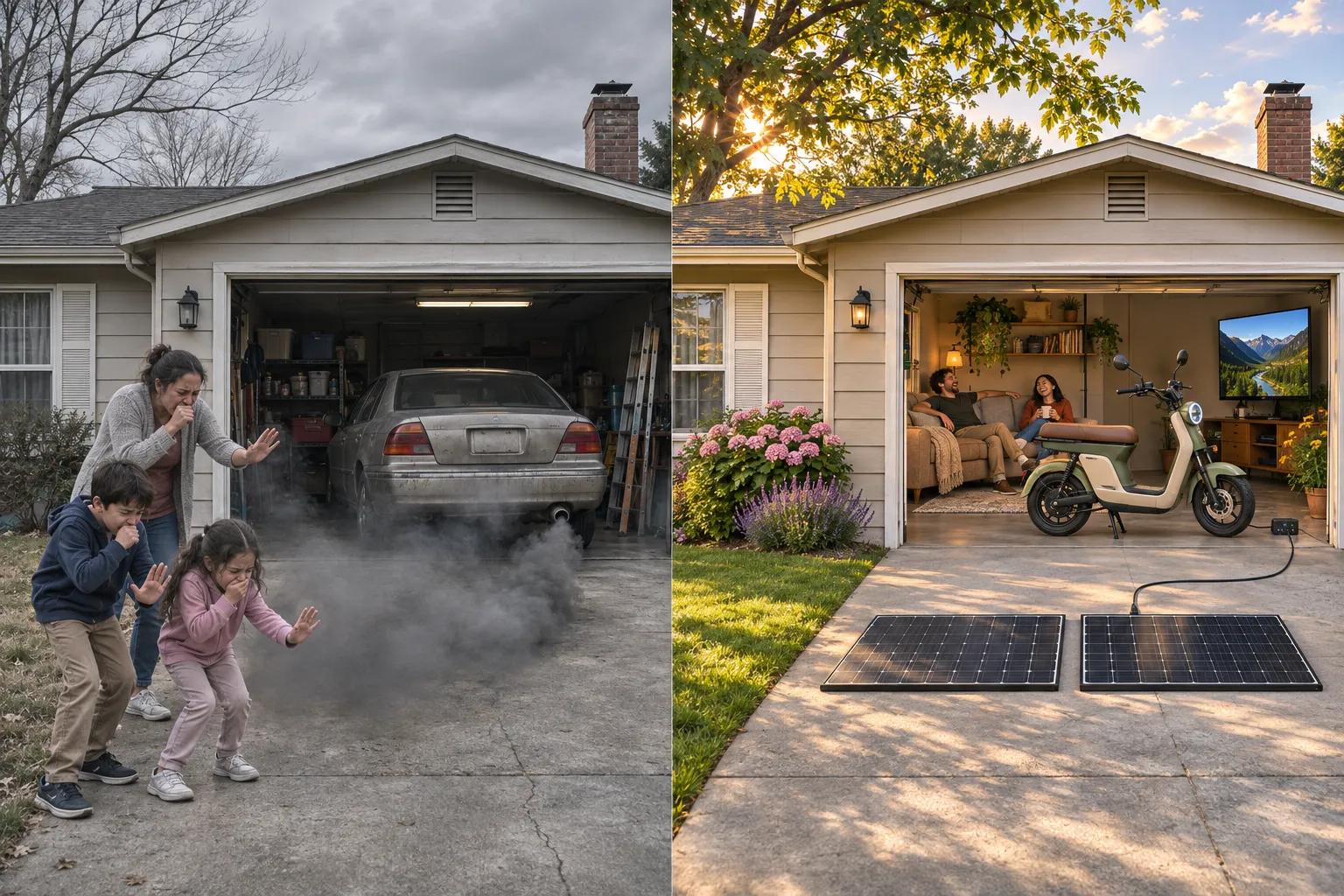
In Your Country, the utility power grid averages 475 g CO₂/kWh (35% coal/fossil share). Charging your LiveWire S2 Mulholland directly from solar eliminates both tailpipe exhaust and power-plant smokestack emissions:
Carbon Emissions per Kilometer (g CO₂/km)
Breathable PM2.5 Air Particles (mg PM2.5/km)
Sources: IEA / Ember Global Average Grid Carbon Intensity (~475 gCO2/kWh); EMEP/EEA Two-Wheeler Emission Inventory & IPCC AR6.
Will Driving a Solar-Charged LiveWire S2 Mulholland Reduce Noise Pollution?
Decibels (dBA) are logarithmic: every +10 dB sounds twice as loud to the human ear. The LiveWire S2 Mulholland's brushless electric motor cuts city pass-by noise by 23 dBA (~80% quieter) compared to a 125cc gas scooter, and solar-charges at 0 dBA:
Is It Legal to Solar-Charge a LiveWire S2 Mulholland in Your Country?
Relevant authority: local utility interconnection rules & your vehicle's road registration
Utility interconnection agreements and roof-solar permits apply to AC photovoltaic systems wired into a home's breaker panel. A portable power station charged by ground- or balcony-mounted panels is a standalone appliance: it never exports to the grid, so there is nothing to interconnect. Two questions stay separate — whether the panel and station need approval (they do not), and whether the vehicle may be ridden on public roads, which is that vehicle's own registration question and is not changed by charging it from the sun.
- No utility interconnection: the station is charged from panels and never exports power.
- No roof work: ground, balcony or carport placement avoids the roof work that usually triggers a permit.
- Road legality belongs to the vehicle: solar charging changes neither its registration, its insurance, nor where it may be ridden.
Ride more or less than 33 km/day? Adjust your daily distance, panel placement and cable runs for the LiveWire S2 Mulholland:
Size Your S2 Mulholland Station Kit →2a · Head-to-head
How does it compare to popular EVs?
Bars are scaled to the highest value in this group. Cost per km = vehicle price + its solar kit + upkeep, over the same distance for every row (33 km/day for 5 or 10 years); a model with no solar kit pays for grid energy instead. Prices are this market's own figures, shown in your display currency.
Price
new vehicle price- LiveWire S2 MulhollandThis model
- $13,532
- LiveWire S2 Del Mar
- $13,532
- LiveWire S2 Alpinista
- $14,797
- Honda WN7
- $16,454
- Stark Varg EX
- $13,911
Top Speed
- LiveWire S2 MulhollandThis model
- 159 km/h
- LiveWire S2 Del Mar
- 166 km/h
- LiveWire S2 Alpinista
- 159 km/h
- Honda WN7
- 129 km/h
- Stark Varg EX
- 129 km/h
Range
- LiveWire S2 MulhollandThis model
- 193 km
- LiveWire S2 Del Mar
- 182 km
- LiveWire S2 Alpinista
- 193 km
- Honda WN7
- 140 km
- Stark Varg EX
- —
Battery Size
- LiveWire S2 MulhollandThis model
- 10.5 kWh
- LiveWire S2 Del Mar
- 10.5 kWh
- LiveWire S2 Alpinista
- 10.5 kWh
- Honda WN7
- 9.3 kWh
- Stark Varg EX
- 7.2 kWh
Motor Wattage
- LiveWire S2 MulhollandThis model
- 63 kW
- LiveWire S2 Del Mar
- 63 kW
- LiveWire S2 Alpinista
- 63 kW
- Honda WN7
- 18 kW
- Stark Varg EX
- 60 kW
Solar Chargeable
— = no plug on record yet- DC charging
- AC charging
- LiveWire S2 MulhollandThis model
- DC charging: No
- AC charging: Yes
- LiveWire S2 Del Mar
- DC charging: No
- AC charging: Yes
- LiveWire S2 Alpinista
- DC charging: No
- AC charging: Yes
- Honda WN7
- DC charging: No
- AC charging: Yes
- Stark Varg EX
- DC charging: No
- AC charging: Yes
Cost per km (5 years)
incl. vehicle + kit + upkeep- LiveWire S2 MulhollandThis model
- $0.24/km
- LiveWire S2 Del Mar
- $0.24/km
- LiveWire S2 Alpinista
- $0.26/km
- Honda WN7
- $0.29/km
- Stark Varg EX
- $0.24/km
Cost per km (10 years)
incl. vehicle + kit + upkeep- LiveWire S2 MulhollandThis model
- $0.12/km
- LiveWire S2 Del Mar
- $0.12/km
- LiveWire S2 Alpinista
- $0.13/km
- Honda WN7
- $0.15/km
- Stark Varg EX
- $0.12/km
Compare them side by side, attribute by attribute →
3 · Station Kit Parts for LiveWire S2 Mulholland
What do you need to solar charge a LiveWire S2 Mulholland?
Click any part below to open the full parts list with safety disclaimers & live retailer links, or adjust your daily distance and cable runs in the free kit configurator. There is no MPPT controller in this list: a station's solar input is already an MPPT, and a second controller cannot be wired into it.
Estimated core kit total: not priced yet
See per-item pricing, electrical safety disclaimers, and direct local retailer links on the full parts list page.
Solar array → the station's solar input
The 1200 W array (1 panel) feeds the station's solar input, not the vehicle. That input is already an MPPT with its own Voc window — it is the only voltage ceiling on this path.
The station banks the day's energy
The station holds 2000 Wh — about one day's riding. The pattern is accumulate-then-dump: the array fills the station through the day and the vehicle takes it in one or two sessions.
The station's AC outlet → the vehicle's own charger
The vehicle's own 4400 W charger plugs into the station's AC output. That charger owns the voltage and current the pack sees, so there is no setting for you to enter.
The AC output's neutral must be bonded
The charging cable checks for a neutral-to-ground path before closing its relay. A floating station is rejected as a ground fault, so a factory-bonded unit or its maker's grounding adapter is a purchase requirement, not an extra.
4 · Safe Charging Order & Recorded Charger Specs
How to Charge a LiveWire S2 Mulholland With Free Solar Power
To charge a LiveWire S2 Mulholland from sunlight, the 1200 W array charges a power station, and the station feeds the vehicle's own charger through its SAE J1772 Type 1 inlet. The order matters: array first, station second, vehicle last — so the AC outlet is never live before its neutral is bonded.
1 · Measure the array's Voc in sun & land it on the station's solar input
Wire the 1 panel to the configuration the plan computed (1S) and check the string's open-circuit voltage with your meter. Never exceed the station's solar-input Voc limit — its input is usually not MC4, so an adapter cable may be needed.
2 · Power the station and confirm its AC output is pure sine
Power the station from solar and confirm no fault code. The output must be pure sine: a modified-sine inverter will make the charger buzz or trip. Check too that the outlet can deliver at least 5500 W.
3 · Bond the outlet's neutral before the vehicle is plugged in
Fit the station maker's grounding adapter first (they are model-specific), then plug the vehicle's cable into the AC outlet. Without this step the cable reads a ground fault and never closes its relay.
4 · Plug in the vehicle's own cable and watch the dash
Use the LiveWire S2 Mulholland's own charging cable. The vehicle's charger starts the session, so the numbers to watch are on the dash and on the station's output load. After ten minutes the battery percentage must be rising.
Recorded LiveWire S2 Mulholland Charger & Inlet Specs
The table lists the battery architecture, the built-in charger's draw at this market's mains, and the inlet's verification status. We never recommend a charge voltage — the vehicle's own charger decides it.
| Nominal Voltage | 400 V |
|---|---|
| Pack Capacity | 10,500 Wh |
| Battery Chemistry | unknown |
| Built-in Charger at 230 V | 4400 W · read from the record's per-mains figures (the maker quotes 5250 W at its highest mains) |
| Vehicle Inlet | SAE J1772 Type 1 · pilot floors at 6 A (1380 W at 230 V) |
| Station Class | 5500 W minimum AC output · 2000 Wh capacity · 1200 W solar input |
| Neutral Bond | No station in this market's catalogue |
Recorded Data Sources
- https://www.livewire.com/products/street-motorcycles — LiveWire lineup: S2 Mulholland at $11,999; 120 mi; 99 mph; 10.5 kWh.
- https://www.livewire.com/bike-comparison/s2-del-mar — Comparison table: 84 hp / 63 kW, L1 8.4 h, L2 142 min, 434 lb.
- https://www.livewire.com/en-gb/s2-mulholland-electric-motorcycle — GB listing, 2026-11-15: LiveWire's en-gb product page for the S2 Mulholland.
- https://www.livewire.com/en-gb/s2-mulholland-electric-motorcycle — GB price, 2026-11-16 (official-store): LiveWire UK 'starting at £10,690' incl. VAT (was £17,890).
- https://www.livewire.com/en-ca/s2-mulholland-electric-motorcycle — Markets, 2026-11-22: LiveWire Canada's S2 Mulholland page ('S2 Mulholland electric motorcycle | LiveWire Canada') priced CAD $16,799. Fetched 2026-11-22. (added CA, CH)
- https://www.livewire.com/en-ch/s2-mulholland-electric-motorcycle — Markets, 2026-11-22: LiveWire Switzerland's S2 Mulholland page ('… | LiveWire Switzerland') priced CHF 10’290. Fetched 2026-11-22. (added CA, CH)
5 · LiveWire S2 Mulholland Solar Charging FAQ & Distance Sizing
LiveWire S2 Mulholland Solar Charging FAQ
Can you solar charge a LiveWire S2 Mulholland?
Yes — but not through a DC kit. The LiveWire S2 Mulholland has no DC charge port: its inlet is SAE J1772 Type 1 and its charger is built into the vehicle (4400 W at 230 V). The solar route is a power station into that charger: a 1200 W array charges the station, the station's AC outlet feeds the vehicle's own cable, and a 33 km day (~1795 Wh) is recovered in about 3 sun hours.
How big a power station does the LiveWire S2 Mulholland need?
Two numbers, and the larger one decides. Its AC output must carry the charger with 25% headroom — at least 5500 W for a 4400 W charger at 230 V. Its battery must bank a day's riding, so 2000 Wh. The station's solar input is usually the third limit: an array larger than that input is array the station cannot absorb.
Why can't an MPPT kit charge the S2 Mulholland?
An MPPT kit feeds a two-wire DC port at pack voltage. The LiveWire S2 Mulholland runs a 400 V pack (10,500 Wh), above the 75 V DC line, and it has no DC port to feed at all — its inlet is AC and the charger that talks to the battery is inside the vehicle. A kit would have nothing to plug into.
Why does my power station refuse to charge this scooter?
Because its AC output floats. The vehicle's charging cable reads the missing neutral-to-ground path as a ground fault and drops its relay, so the vehicle does not charge even though the station is running. The fix is the station maker's grounding adapter — model-specific, never universal — or a unit whose output is bonded from the factory. This is what makes most power stations refuse a vehicle.
Can I use the S2 Mulholland's own charging cable from a power station?
Yes, as long as the station meets the numbers above. One constraint: a SAE J1772 Type 1 cable cannot advertise less than 6 A, so the smallest load it can present is 1380 W at 230 V — the station has to sustain that continuously, not just at start-up. Pure sine only; a modified-sine inverter will buzz or trip on this load.
How many panels to charge the whole pack in a day?
A full 10,500 Wh in one sunny day needs about 6900 W of array — a far bigger number than the 1200 W a 33 km/day commute needs. For daily riding the pattern is accumulate-then-dump: the array banks the day's energy in the station and the vehicle takes it in one or two sessions.
Can I charge while riding?
No. The system is designed for stationary daytime charging, with the panels in full sun and the station in ventilated shade. Many vehicle BMS units also inhibit throttle output while the charge inlet is active.
Sunshine Hours & Array Sizing by Daily Distance (10–40 km/day)
Computed from a consumption rate of 54.4 Wh/km, the AC path's conversion chain (station PV input × inverter × the vehicle's charger ≈ 70%), a 0.70 panel derating factor, and 3.1 peak sun hours/day in United Kingdom. The last column is the sun hours the array needs to put the day's energy back — when it exceeds the market's sun hours, this station does not close the day.
| Daily Distance | Daily Wh | Array (needed → bought) | Sun Hrs to Recover | 0–100% Full Pack |
|---|---|---|---|---|
| 10 km/day | 544 Wh | 400 W → 400 W (1 panel, 1S) | 2.8 hrs | 17.2 sunny days |
| 20 km/day | 1088 Wh | 750 W → 750 W (1 panel, 1S) | 2.9 hrs | 9.2 sunny days |
| 30 km/day | 1632 Wh | 1100 W → 1100 W (1 panel, 1S) | 3 hrs | 6.2 sunny days |
| 33 km/day | 1795 Wh | 1200 W → 1200 W (1 panel, 1S) | 3 hrs | 5.7 sunny days |
| 40 km/day | 2176 Wh | 1450 W → 1450 W (1 panel, 1S) | 3 hrs | 4.7 sunny days |