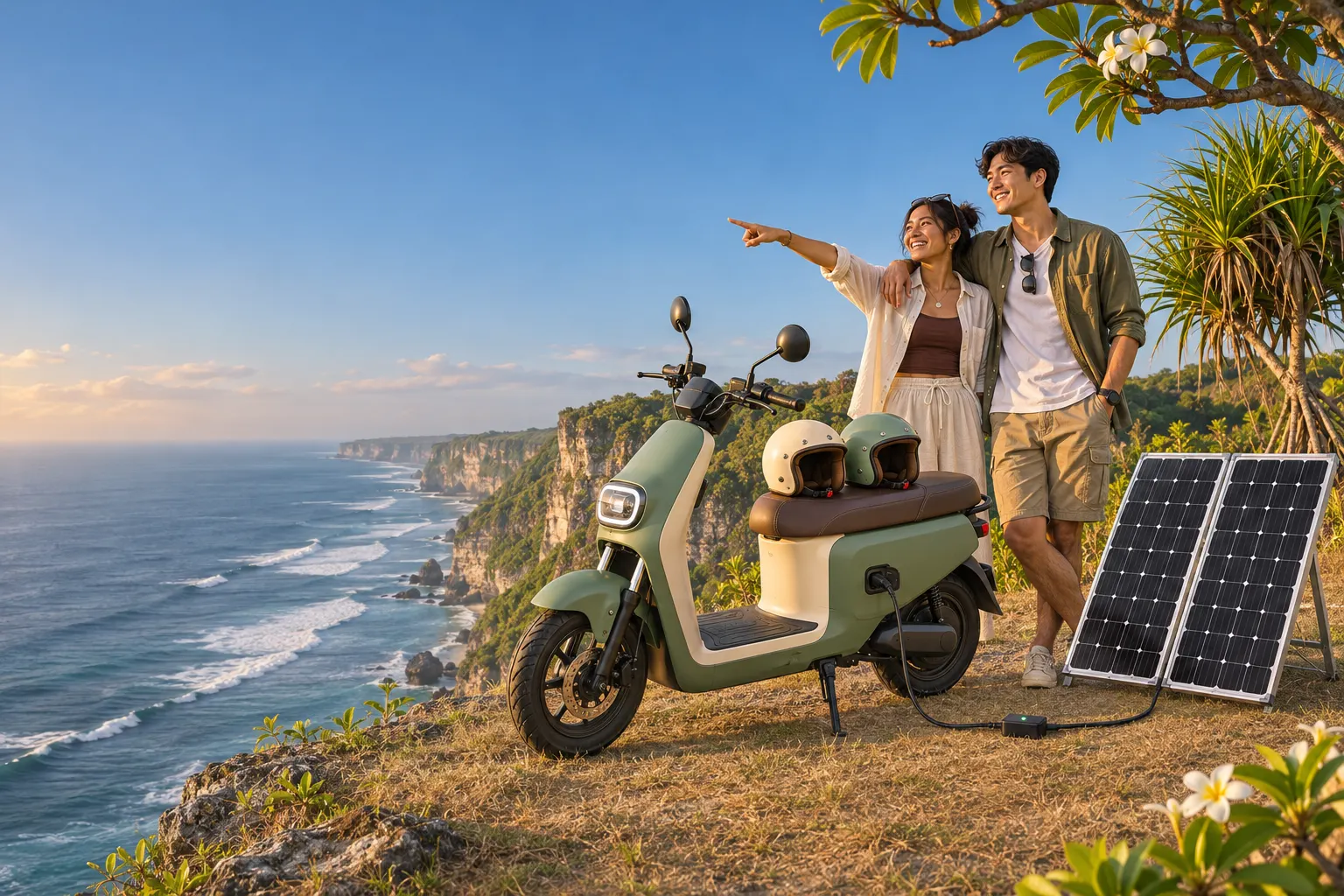
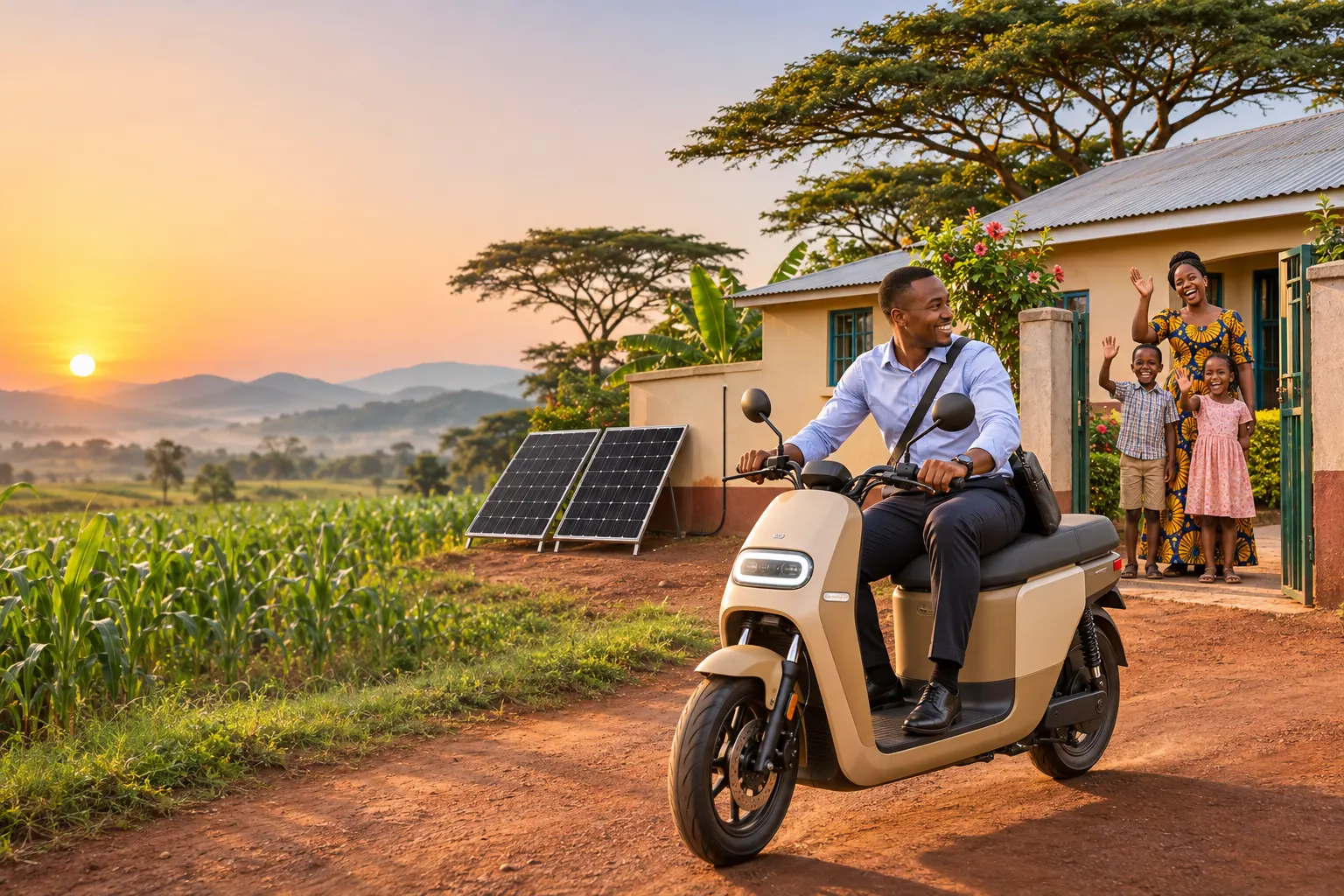




A laughing Indonesian couple riding a sage-green electric scooter along a lane through Bali's terraced rice fields on a clear morning, with coconut palms and Mount Agung on the horizonA couple standing on the Uluwatu clifftop above the ocean beside their electric scooter, which is charging from a two-panel solar kit propped on the grassA young father in a light blue shirt riding an electric scooter out of his village at sunrise, past his wife and two children waving at the gate and a two-panel solar kit standing on the groundA couple riding a light electric bike across a sunlit desert playa on a clear morning, leaving a long trail of dust beneath a deep blue sky

Free Clean Fuel.

How?

Solar charging kits for light EVs

Pick your scooter, motorcycle or e-bike. Plug in one or two solar panels. Never pay for fuel again.

How It Works

Never Buy Petrol Again for Under $500

Charge your ride from the sun. We size the kit to your commute and your local sun for free. Then we show you where to buy the parts and how to assemble them.

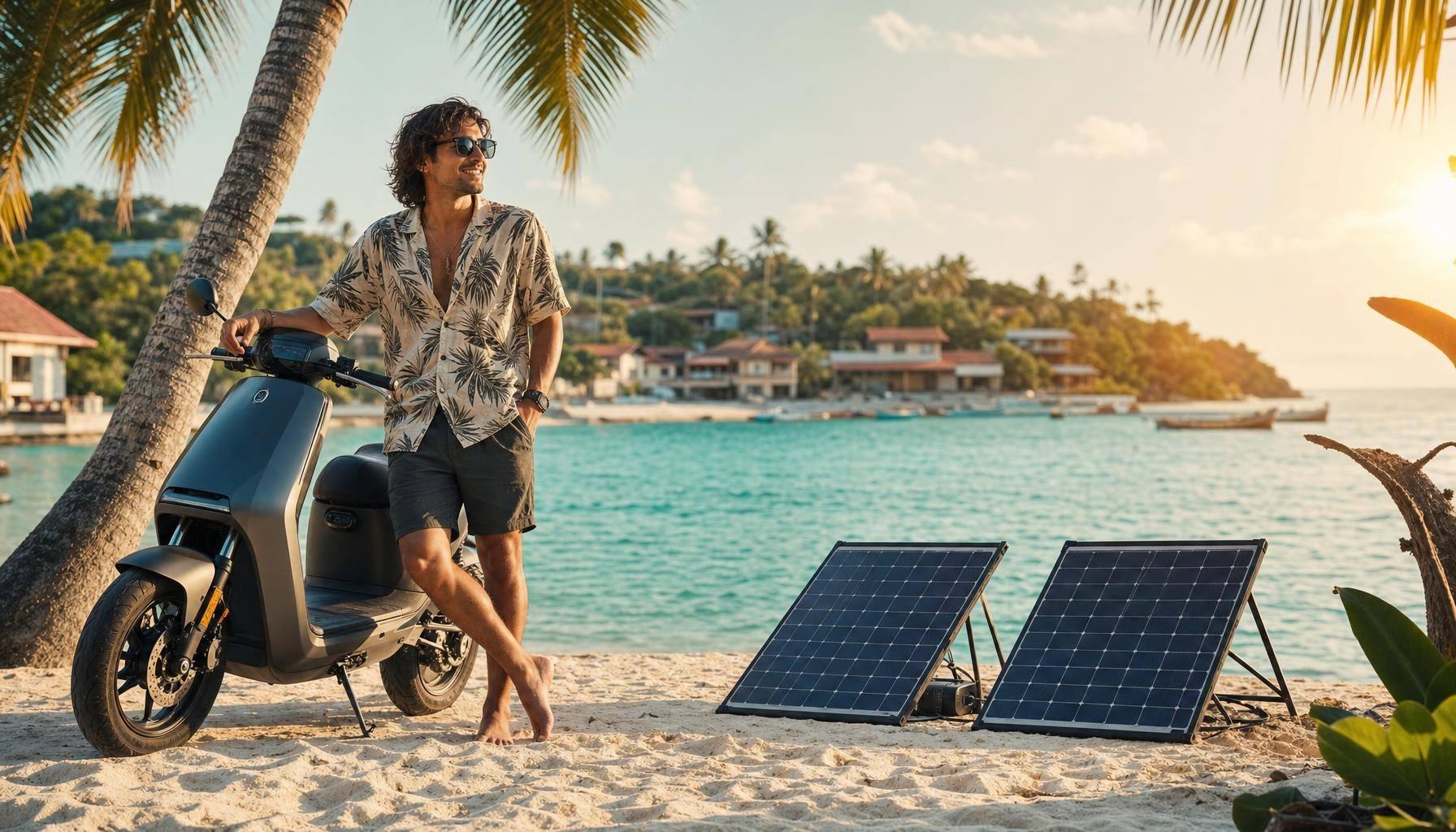
A rider beside an electric scooter with two portable solar panels charging on a tropical beach
  • Never buy petrol

0 liters

of petrol. Ever again.

~2 years

to pay for itself — then the fuel is free

No installer

no permits, no engineering, no grid connection

No electric vehicle yet? Even better.

Browse solar-chargeable light EVs by country

Browse light EVs

You Choose

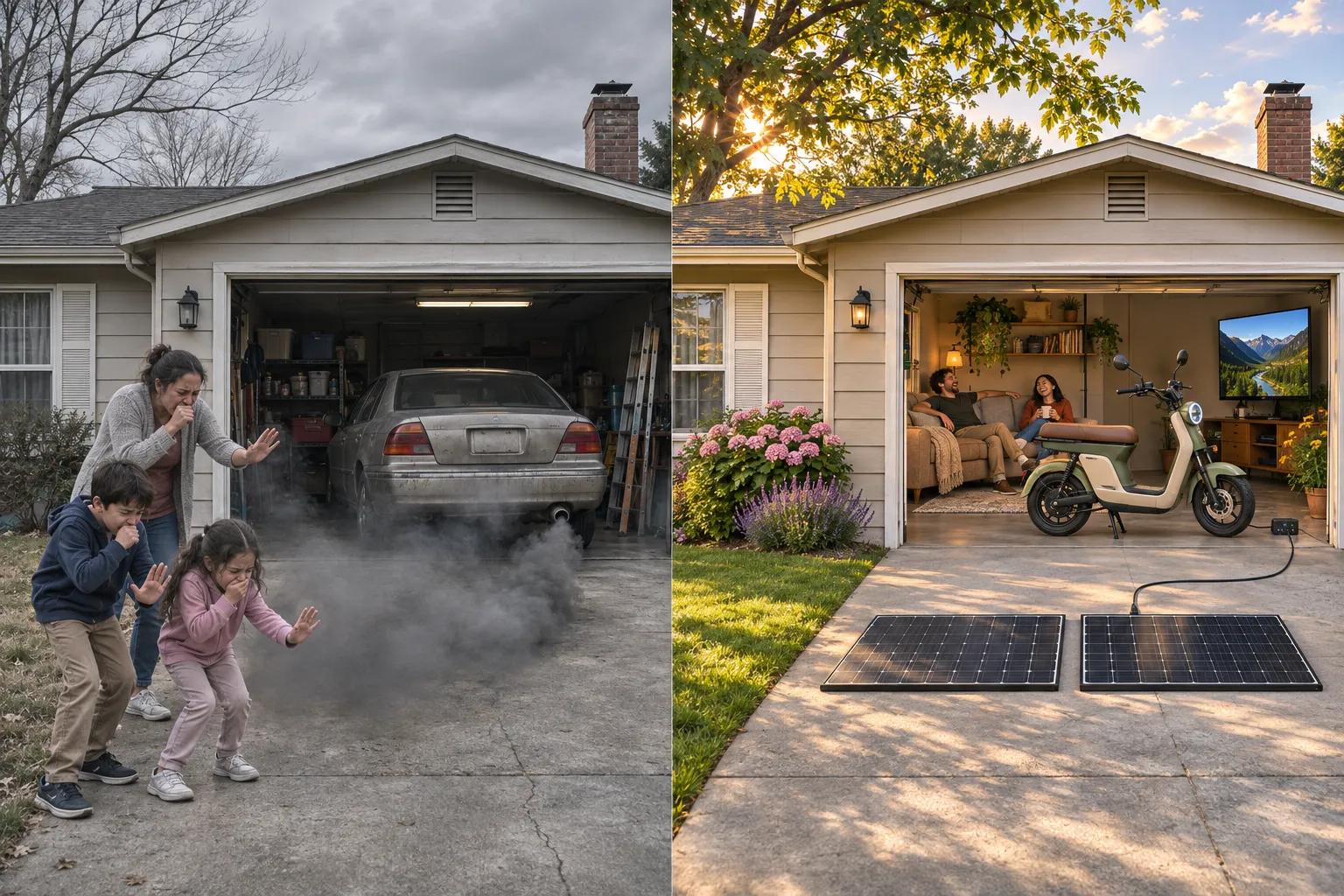
One garage. Two futures.

Same miles, every cost counted, from purchase to resale. How much does a solar-charged electric scooter save over a petrol car?

The same suburban garage twice: on the left, a car idling with exhaust smoke and children coughing on the driveway; on the right, the garage open with a couch, a TV, an electric scooter, a wall-mounted charge controller and two solar panels in the sun
PetrolSunshine
$36,836saved over 10 yearsabout $3,684 a year

Toyota Corolla

  • Vehicle, less resale$16,000
  • Fuel$5,486
  • Insurance$17,000
  • Maintenance & repairs$5,100
  • Registration$1,200
Ten years, all in$44,786

$0.75 per mile

Electric scooter

  • Vehicle, less resale$3,900
  • Solar kit (2 panels + MPPT)$450
  • Fuelfree, from the sun
  • Insurance$1,500
  • Maintenance & repairs$1,800
  • Registration$300
Ten years, all in$7,950

$0.13 per mile

Estimates for a US driver: 60,000 miles over 10 years, 35 mpg at $3.20/gal, $0.13/kWh (not charged — the panels cover it), full-coverage insurance at $1,700/yr for the car and $150/yr for the scooter, maintenance at $0.085 and $0.03 per mile, one battery pack inside the ten years. Your numbers will differ; the calculator uses yours.

Size my kit

Disruptively simple

We estimate ~6% of the population can transition away from gas to solar today, reducing both pollution and cost per mile. That is about 6 in 10 of the world's motorcycles and scooters.

  • 1–2 panels, all year
  • 3–4 panels, all year
  • Too little winter sun

Bigger dot, more people. Dimmer dot, denser city and less room for panels.

How we estimated this

Sun: a 20 km day at 30 Wh/km, on 100 W panels at 70% of nameplate, in the darkest month of the year. A place counts if 4 panels or fewer cover it. NASA POWER 20-year climatology, cloud included.

Space: the share of people with a yard, roof or balcony for a panel, from 90% in the countryside down to 20% in cities of 5 million or more. This is our assumption, not a measurement.

Riders: we only count people who already ride a powered two- or three-wheeler, about 10 for every 100 people worldwide, from each country's registered fleet (WHO, 2023).

It leaves out price, road rules and how far each rider goes in a day, so it is what is possible, not a forecast. On two panels alone the figure is ~2%. Counting everyone who has the sun and the space, rider or not, it would be ~52%. Population: World Bank and GeoNames. Map: Natural Earth.

What's in a Kit

Follow the Energy

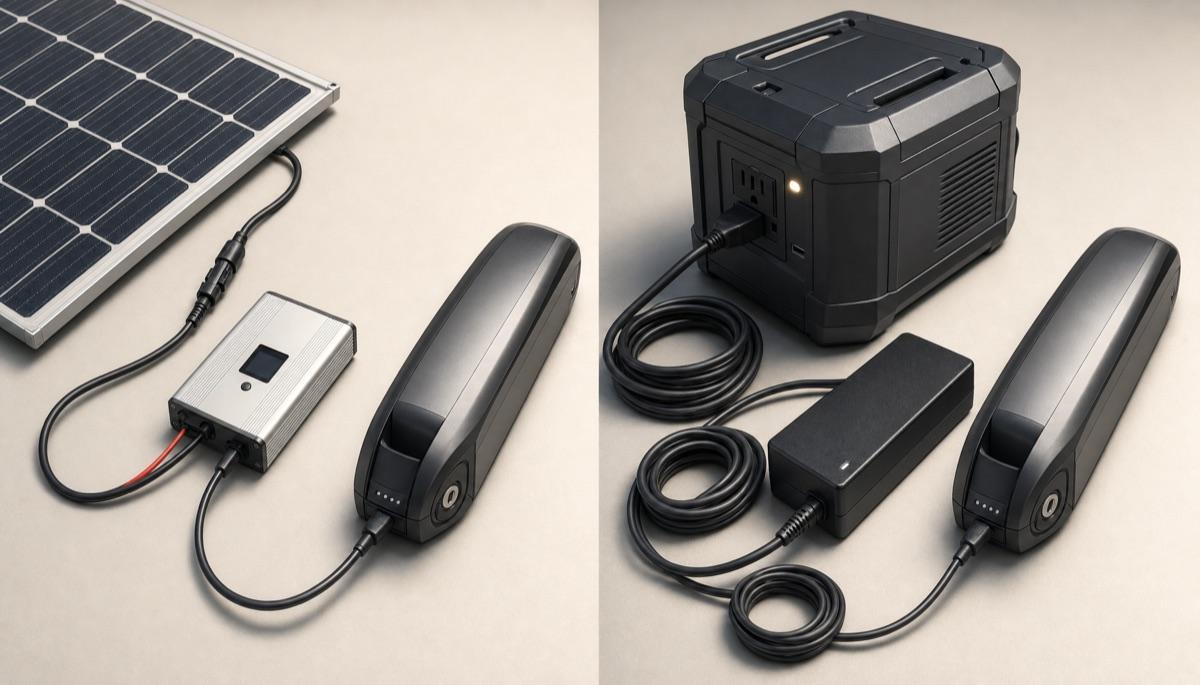
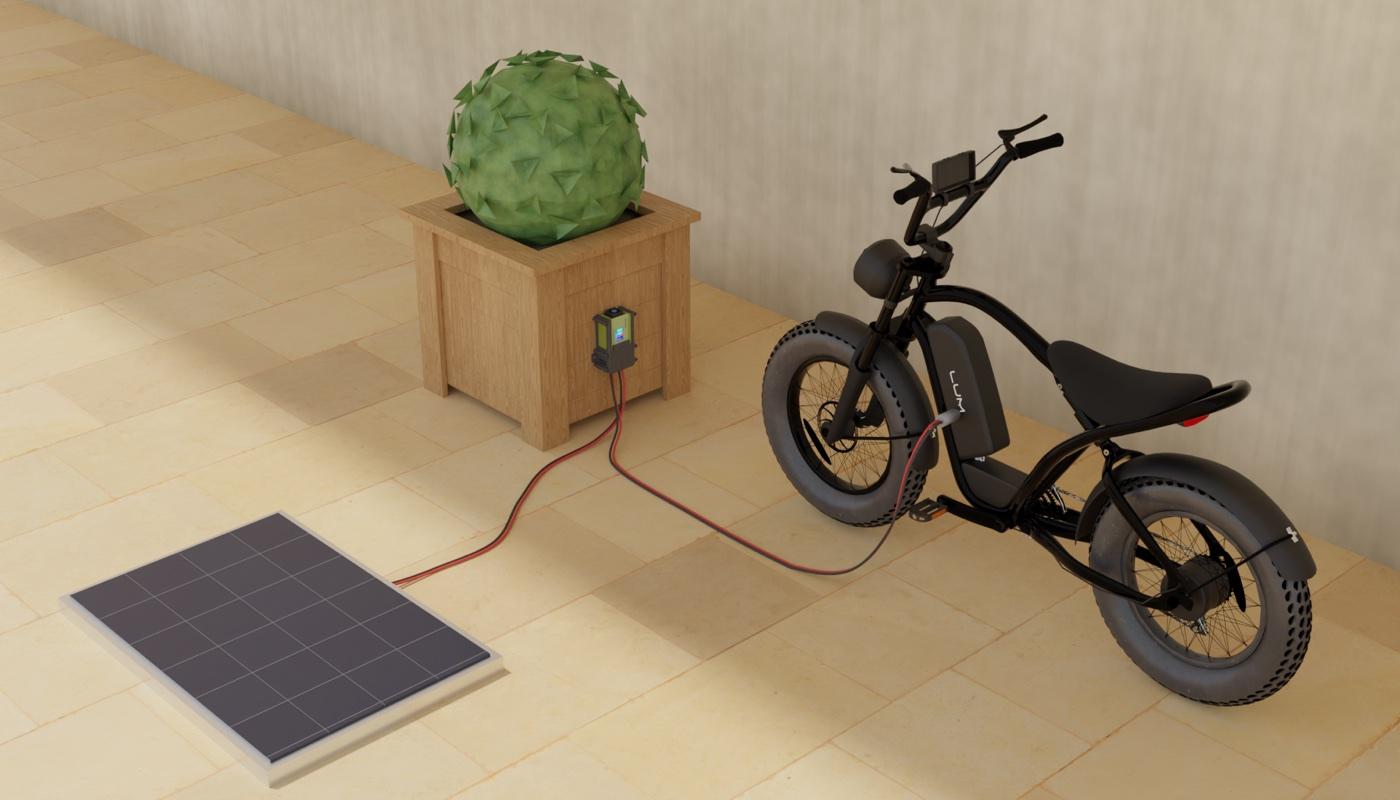
Four parts, in the order the current flows through them.

An assembled ScootSolar kit: a solar panel on the paving, the MPPT controller strapped to a planter, the cables between them, and an e-bike charging in the shade.

Solar panel

Converts sunlight into DC electricity. Sized to your daily distance and local sun hours — usually one or two foldable panels, not a rooftop array.

Weatherproof and portable. Put them on the ground, or anywhere that works.

Tap any part to see where it sits in the kit

Our Shop

Start Free. Add What You Need.

The configurator costs nothing. Below it are the parts we designed, printed and tested ourselves — files you can download and send to a 3D print shop.

Free

Light EV Solar Kit Configurator

Pick your country and your ride, set how far you go in a day, and it sizes the whole kit: array wattage, charge controller, fusing, cable and the exact connector for your charge port.

  • Sized to your real commute
  • Only ports we've verified
  • No account, no email
Open the configurator

Free to use, forever. Nothing is charged until you order parts.

2 panels

Ride further, add a panel. The configurator works out how many.

Only Found on ScootSolar

The instructions and the parts nobody else makes — designed, printed and tested by us.

Instructions + AI

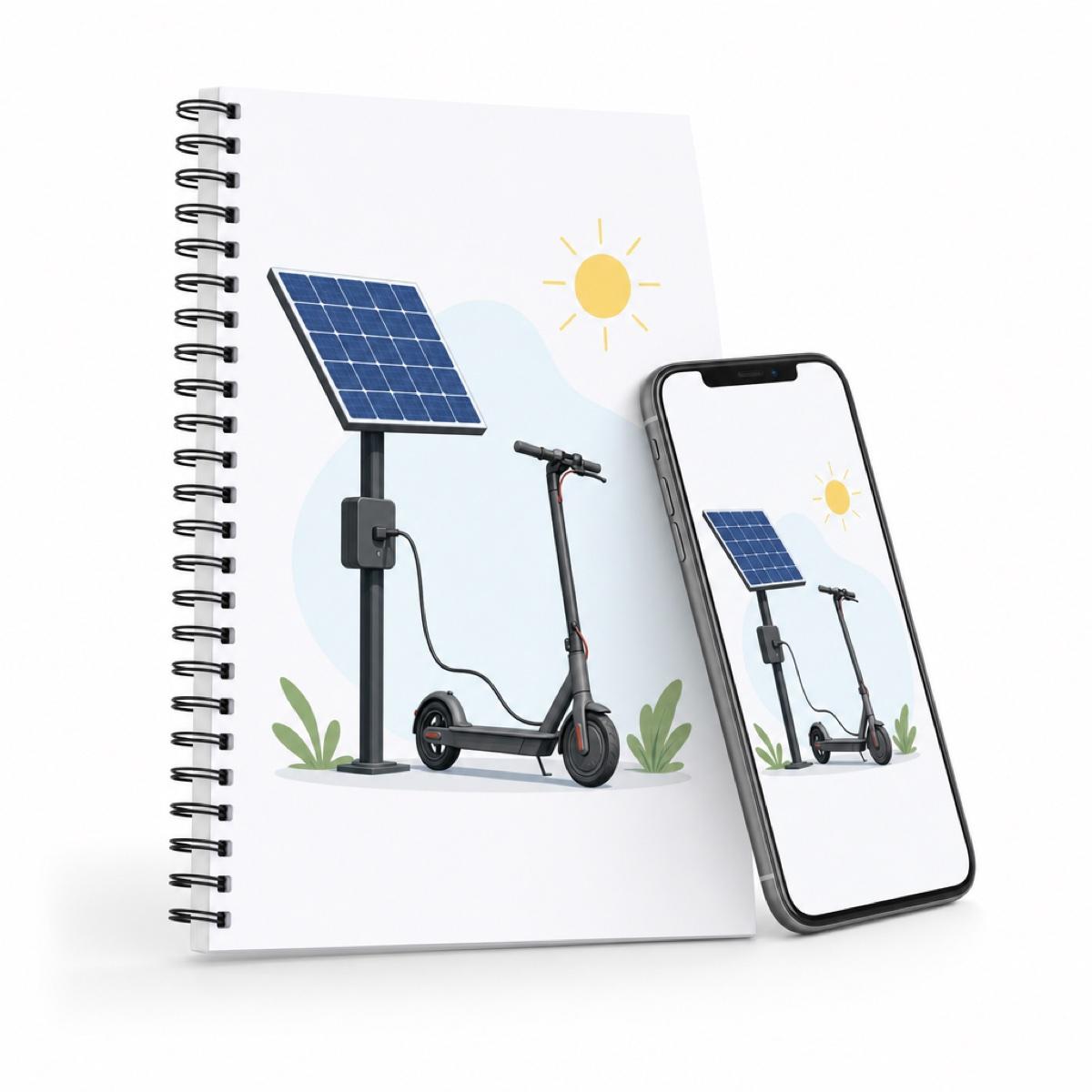
Mobile Build Instructions & AI Build Assistant

Step-by-step assembly for your exact kit, on the phone in your hand. Stuck on a step? Share a photo and ask.

  • Written for your kitYour vehicle, your panels, your connector — not a generic manual
  • Share photos, ask questionsThe AI assistant answers wiring questions while you build
  • Instant accessOpens on your phone the moment you check out

Get the instructions$19.99
Charge Controller Safety Housing

Trip-Proof Your Charge Controller

A two-piece printed shell for the 1200 W boost MPPT. It takes the knocks, so the wiring doesn't.

  • Wire strain reliefRibbed clamps grip both battery leads ahead of the terminal
  • Trip safeA tug pulls on the shell, not on the stripped copper
  • Tamper-proofThe voltage selector and Set button sit under a bridge
  • Easy to mountFour mounting ears, four M3 screws, fan and vents left open

See the housing$9.99

PV Cable Wire Guide

Run PV Wire Anywhere, Safely

Safely and easily screw PV wire into the ground, and around objects.

  • Screws to the groundOne stake or ground screw through each joint
  • Safe bend radiusHolds the cable pair on a fixed 115 mm curve
  • Snaps together45° bends and 120 mm straights, no zip ties

See the wire guideFree

PV-to-EV Adapters

The Plug Your Charge Port Is Missing

Printed adapters that take solar cable straight into your EV's own charge port. First: the NIU FX Pro port nobody else makes an adapter for.

  • No soldering, no crimpingA hex key clamps the stripped cable in the contact
  • Fits the stock portNothing on the scooter is cut or modified
  • 4 mm² or 6 mm² PV cableThe gauges solar panels already use

See the NIU FX Pro adapter$9.99

Browse every part in the catalogue →

Guides

Learn Before You Build

Free, visual guides to make installing and maintaining your solar kit easy and safe.

4 steps · 12/10 AWG

How to crimp an MC4 connector

Most solar panels come with MC4 connectors already on the back. They are the industry-standard way to connect or splice PV wire safely — learn to crimp one and you can make any cable run your kit needs.

  • Already on your panelMost panels ship with a pair of MC4 leads on the back
  • WaterproofA sealed, locking connection made to live outdoors
  • Four steps, one animationStrip 8 mm, crimp, snap into the housing, tighten the nut

Open the crimping guide

Early Builds

Be One of the First Builds

ScootSolar is new. Build a kit, show us, and yours could be the first one here.

Built yours? Tag us or send a photo. We feature early builds.

Latest News

New Vehicle Kits & Hardware Releases

Recent vehicle kit launches, verified charge-port connectors, and 3D-printable strain-relief hardware from the ScootSolar lab.

The Problem

Burning Fuel Costs More Than Money

Petrol is a subscription you can't cancel

Every kilometer costs money, every month, forever. An electric motor has almost no running cost — but only if the electricity is free.

The exhaust doesn't leave when the engine stops

Particulate matter and NOx hang in the air long after the engine is off — the air your family breathes.

You rent your fuel — you don't own it

A price rise, a strike or a shortage and the pump runs dry. Every liter is a bill someone else sets. Power you make yourself can't be priced, rationed or cut off.

The wall socket isn't free — or clean

Grid power costs money, and across much of Asia it's still generated largely from coal and gas. Plugging in is neither zero-cost nor zero-carbon.

Our Answer

Solar, Minus the Headache.

You shouldn't have to learn electrical engineering to go green. Use our configurator instead.

Sized to your ride

Array wattage, charge controller and cable are computed from your vehicle and how far you actually travel — not a one-size kit.

Plugs into what you already have

It connects to the charge port you use today. Nothing is rewired inside the vehicle, and there's no battery to buy.

We do the hard part

Charge voltage and connector matched to your model, with fusing, polarity protection and a controller rated for the array.

How It Works

Three Steps, No Electrician

1

Tell us where and how far

Pick your country and vehicle, then set your daily distance. We use your local sun hours, not a global average.

2

We size the kit

Array wattage, MPPT controller and the exact adapter for your charge port — matched to your pack's charge voltage.

3

Mount, plug in, ride

Panel on a balcony, carport or the ground. Plug into the charge port you already use — nothing is spliced into the vehicle.

Why Solar

A Parked Vehicle Is a Parked Array

Charge while it sits outside. The fuel bill goes to zero.

Free fuel, every day

A parked scooter is a parked solar array. Charge from sunlight and the running cost goes to zero.

No battery to buy

Your scooter already has one. That's most of the cost gone.

Built for weak grids

Islands, rural roads and outage-prone areas: the sun doesn't have a schedule or a bill.

Tropical sun is ideal

4.5–5.5 usable sun hours a day across Southeast Asia — enough to recover a daily commute.

No permits, no installer

Nothing is bolted to a building or wired into a mains circuit. You put the panels in the sun, charge, and ride.

Portable by design

The kit isn't installed — it's yours to move.

Zero tailpipe emissions

Every kilometer on sunlight is a kilometer not burned as petrol.

Popular Setups

Kits Riders Are Asking For

Sized for each market's own daily commute at local sun hours. Pick one to load it into the builder.

Buying With Confidence

What We Stand Behind

Accelerating global sustainability

Every kit turns sunlight into your daily ride — replacing petrol kilometers with clean, off-grid energy.

Voltage-matched or it doesn't ship

We confirm your charge voltage and connector before dispatch. If we can't match it, you don't pay.

Support that answers

Real help with wiring, connectors and charge profiles — in English and the local language where we can.

FAQ

Questions Riders Ask

How much solar do I need to charge my electric scooter?

It depends on how far you ride. A 20 km daily commute on a 72V scooter needs roughly 100–200W of panel; a full recharge of a 2.4 kWh pack in one day needs closer to 800W. The builder sizes it from your own distance, vehicle and local sun hours.

Do I need to buy a battery with the kit?

No. Your scooter or motorcycle already has a battery — the kit charges it through the charge port you already use. That's why there's no battery in the box, and why the kit is cheaper and lighter than a power station.

Will it charge on cloudy days?

Panels still produce on overcast days, but at a fraction of their rated output. During a heavy rainy season, treat solar as the primary charge and your wall charger as the backup.

How long does a full charge take?

It scales with array size and pack size. A 100W panel recovers a typical daily commute in a day of sun; a full recharge of a large e-motorcycle pack can take two to four days on a small array. The result screen shows this for your exact setup.

Will it work with my scooter?

Compatibility comes down to two things: your pack's charge voltage and your charge-port connector. We only list connectors we've verified — if we haven't confirmed yours, the builder says so rather than guessing.

Is it safe?

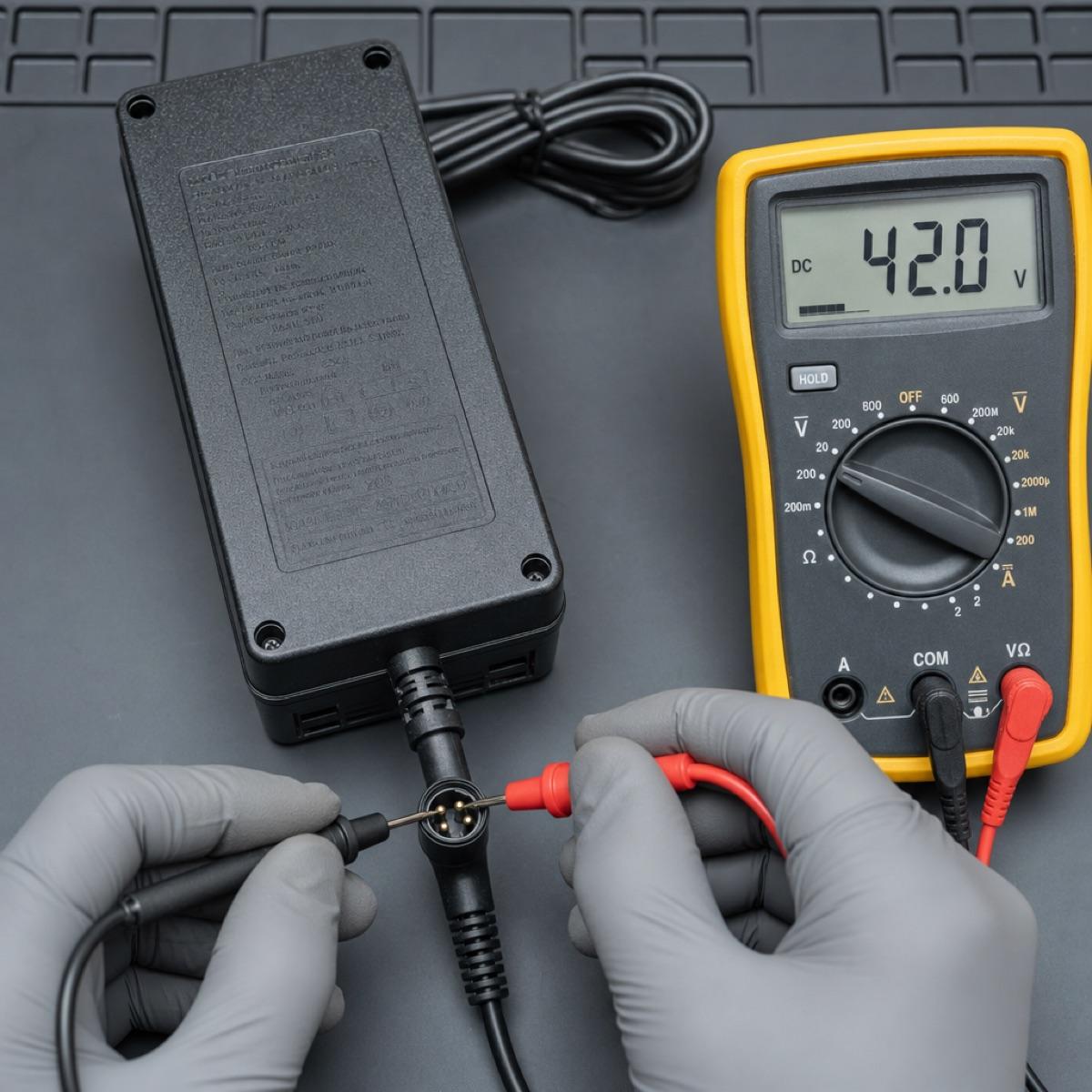
The controller is a proper MPPT unit with overvoltage, overcurrent and reverse-polarity protection, and the kit is fused. The critical rule is to match your original charger's voltage — never exceed it. Every kit ships with the correct charge profile for your model.

Do I need an inverter?

No. Your vehicle charges on DC, so the kit stays DC the whole way — panel to controller to charge port. An inverter would only add cost and losses.

Do I need a permit or an electrician?

No. The kit is a portable DC appliance, not a grid-connected installation — it isn't wired into a building's mains circuit. That's what keeps it simple and cheap compared to rooftop solar.

Can I leave the panel outside?

Yes, the panels are weatherproof, but they should be secured against wind and theft. Keep the controller sheltered and dry.

Where do you ship?

Kits ship to Thailand, Vietnam, Indonesia and the Philippines today, expanding from there. Adapter cables ship more widely.

How long until it pays for itself?

Compared with petrol, typically one and a half to three years depending on your daily distance and local fuel prices. The calculator shows the payback for your inputs.

Find out what your ride costs on sun

Five questions, no sign-up, and a real answer for your country, vehicle and daily distance.

Open the kit builder