
How Many Watts of Solar Do You Need to Charge an Electric Bike?
A single 100 W solar panel is all you need for a typical daily e-bike ride (up to 30 km a day). Even an e-bike needs a small boost MPPT controller between the panel and the battery to regulate current and step the panel's 18 V up to your battery's charging voltage. Laid flat on the ground in the sun, one 100 W panel puts a 20 km commute back into a 36 V or 48 V e-bike battery in about 2.5 hours of sunshine.
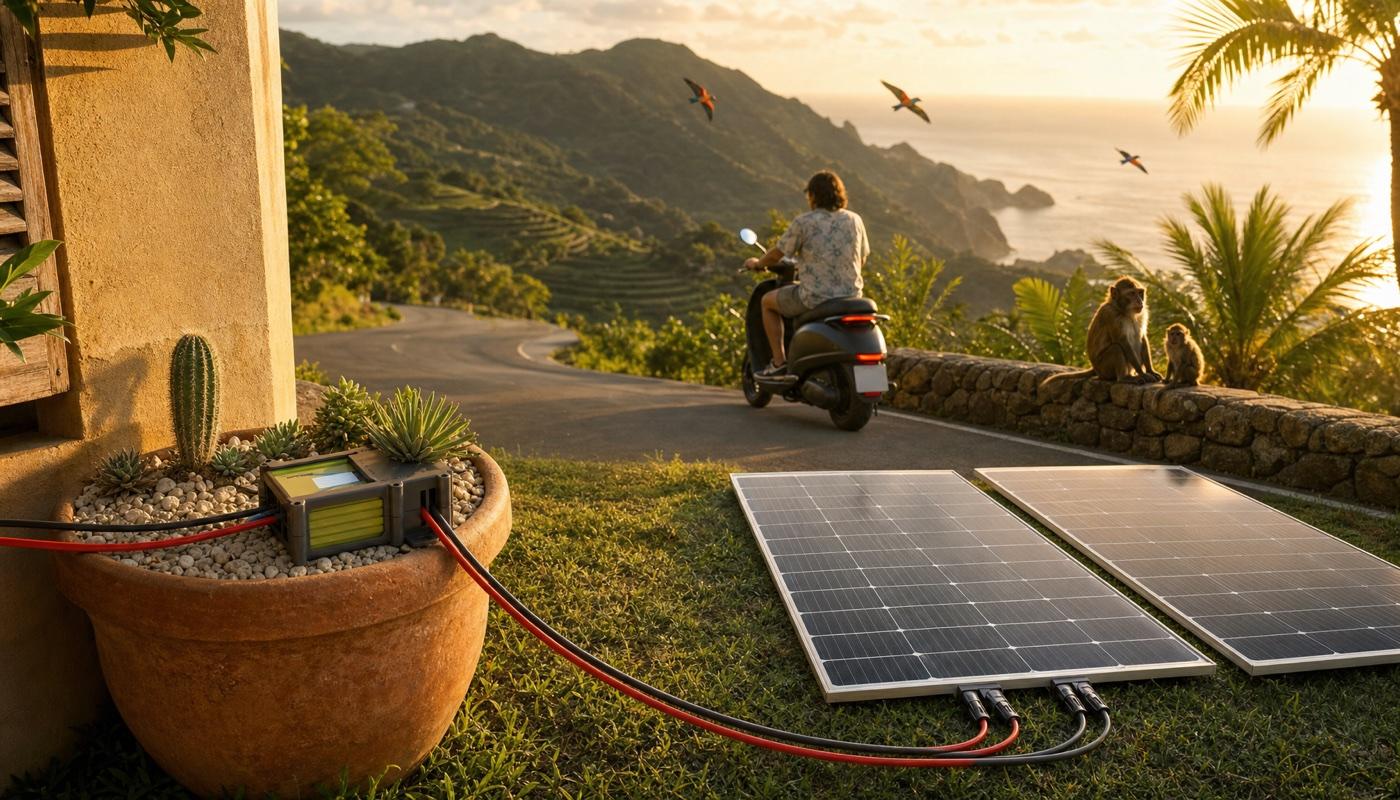
A single 100 W panel laying flat in the sun: this feeds our MPT-7210A boost controller, in its custom strain-relief shell, and straight into the e-bike's battery port.
1 × 100 W
Single flat panel for rides up to 30 km/day
~2.5 hrs
Sunshine needed to recover a 20 km ride
~1.3 yr payoff
Avg. payoff vs. gas (~$415 complete kit)
See Your Exact Parts List and Payoff Period
Pick your bike or scooter in our solar kit configurator to price every part and see how fast free sunlight pays back the kit.
How Many Watts of Solar Do You Need to Charge an Electric Scooter?
For a sit-down electric scooter, moped, or off-road e-moto (52 V, 60 V, or 72 V — such as a NIU NQi / UQi, Voro EMOVE Cruiser, Segway Ninebot Max, or a 60 V Sur-Ron Light Bee X / Talaria), step up to 200 W of solar — two 100 W panels laying side by side and wired in series. Because a full-sized scooter or e-moto uses about twice as much energy per mile as a pedal-assist e-bike, two panels double both your power and your voltage (36 V) into the boost MPPT controller, recovering a 20 km daily ride in about 3.4 hours of sun.
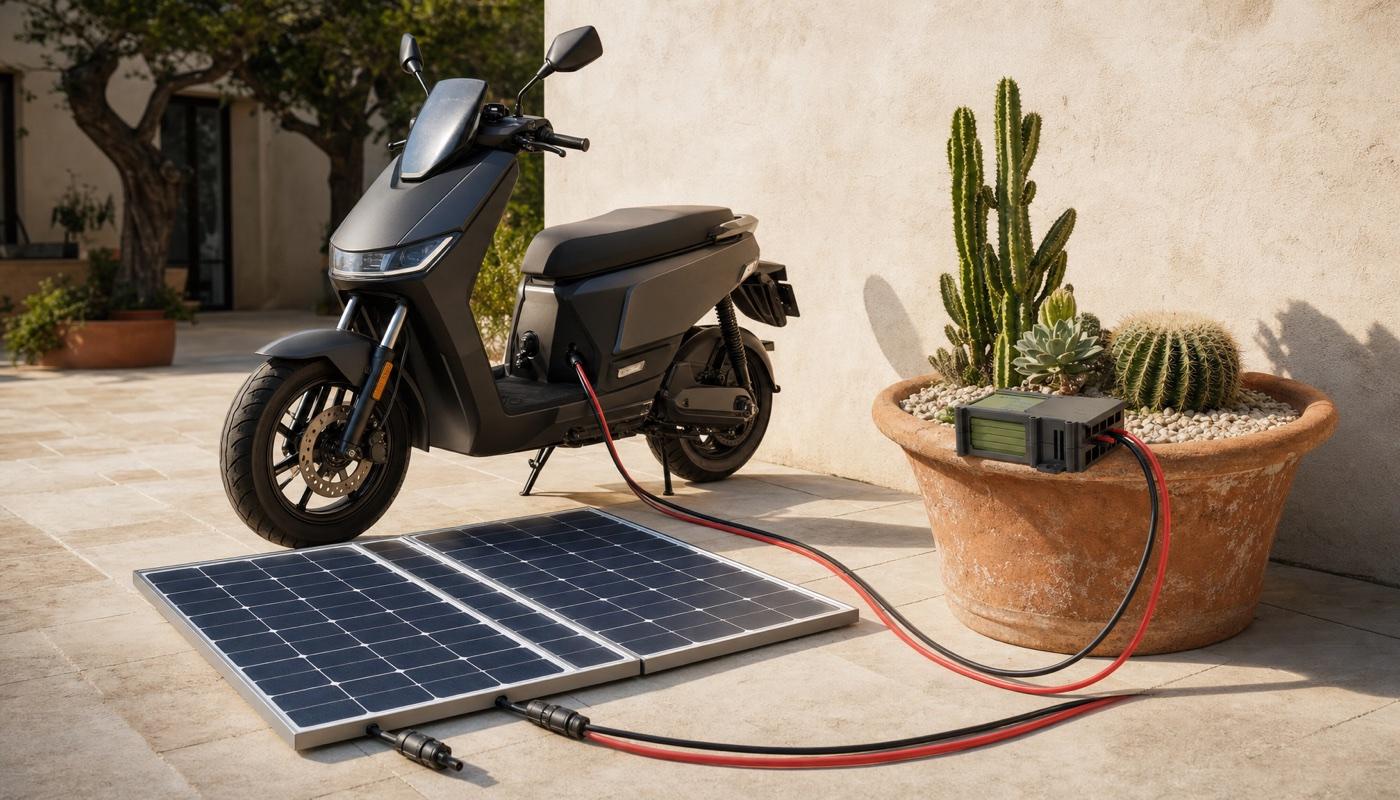
Two 100 W panels wired in series (200 W total) laying on the ground feed the wall-mounted MPT-7210A boost housing and straight into a 72 V sit-down electric scooter.
2 × 100 W (200 W)
Two 100 W panels wired in series (36.2 V)
~3.4 hrs
Sunshine needed to recover a 20 km scooter commute
~1.9 yr payoff
Avg. payoff vs. gas (~$524 complete kit)
Cost & Lifetime ROI
How Much Do These Solar Kits Cost?
A direct solar charging kit costs a fraction of a solar generator because your bike or scooter already has a large lithium battery inside it. Instead of paying $500+ for a second battery and losing ~25% of your sunlight to an AC inverter, you only buy the four parts that move sunlight into your existing pack:
~$415
Includes 1 × 100 W panel, boost MPPT in its strain-relief shell, 5 m MC4 cable, and charge-port lead. Pays for itself in ~1.3 years of daily riding.
~$524
Includes 2 × 100 W panels wired in series, wall-mounted boost MPPT, solar cables, and vehicle plug. Pays for itself in ~1.8 years of commuting.
Cumulative Fuel Savings vs. One-Time Solar Kit Cost
~3 yrs
Payoff breakeven point vs. buying gas
+$350
Net 5-year savings after paying off kit
+$1,500
Net 10-year profit (panels last 25+ years)
How It Works · Direct DC Flow
How Does Solar EV Charging Work?
Both solar panels and batteries are DC power, rather than AC power, which is great because it means you don't need any expensive inverters. But you still can't plug a solar panel right up to any battery.
A 100 W solar panel naturally runs at around 18 V, while a 48 V e-bike battery needs 54.6 V to charge (and a 72 V scooter needs 84.0 V). Click any node in the full flow diagram below to see how the parts connect from sunlight to your battery:
3. Boost MPPT Controller (in Custom Strain-Relief Shell)
The brains of the kit: steps the panel's 18–36 V up to your battery's exact charging voltage (e.g., 54.6 V or 84.0 V), regulates current safely, and sits inside our custom 3D-printed strain-relief & button-locking shell.
The Brains of the Kit
What Is an MPPT Charge Controller, and How Does It Work?
MPPT stands for Maximum Power Point Tracking. A solar panel's output shifts constantly as clouds drift by or the sun moves across the sky. An MPPT controller acts like a smart automatic transmission between the panel and your battery — continuously adjusting its electrical load to lock onto the panel's sweet spot and harvest 20% to 30% more energy than a basic controller.
From 18 V Panel Power to 54.6 V or 84.0 V
Standard RV solar controllers only step voltage down for 12 V batteries. A boost MPPT steps 18–36 V from one or two panels up to the exact voltage your e-bike or scooter battery needs.
Protects Your Battery Like an OEM Charger
As your battery fills up, the MPPT smoothly tapers the current at your pack's exact voltage ceiling and shuts off automatically when full.
Engineered for Everyday Safety
Are Solar E-Bike and Scooter Kits Safe?
Off-the-shelf solar controllers were built to live inside a locked utility cabinet — not on a patio or driveway where someone can trip over a charging cord or bump a voltage button. Thanks to custom 3D-printed safety parts we designed specifically for light electric vehicles, charging from the sun at home is now dramatically safer:
Check your battery's charging temperature. A lithium pack must not be charged below the minimum on its label — the battery's BMS refuses the charge until the pack warms up, so a cold morning can leave the solar kit with nothing to send.
Custom MPPT Strain-Relief Housing
Clamps both the solar and battery cables so a tug never reaches the screw terminals, and locks a protective shield over the voltage adjustment buttons so your setting can never be bumped accidentally. Adds mounting points for easy & safe placement.
NIU FX Pro Custom Charge-Port Adapter Housing
When a scooter uses a proprietary charging socket no shop sells a plug for, we caliper-measure the factory port and design a keyed 3D-printed housing with built-in strain relief.
PV Cable Bend & Wire Guide
A PV cable bent tighter than its minimum radius cracks the insulation and breaks strands inside it. Interlocking 45° segments hold the pair on a fixed bend and stake into the ground, so the run from the panel to the controller stays off the driveway instead of lying loose where it can be kicked, kinked or walked on.
Getting Started · Never Buy Gas Again
How Do I Get Started If I Want to Never Buy Gas Again?
Whether you already ride an e-bike or scooter — or you're still riding a gas moped and want to see how fast switching to electric + solar pays for itself — you can set up your kit in three steps:
Size Your Ride in the Configurator
Pick your model (or choose 'I don't have one yet' to compare vehicle classes) and get your matched panel, controller, and cable list.
Check Your OEM Charger Label
Read the DC OUTPUT voltage printed on your original wall charger brick (e.g., 54.6 V or 84.0 V) and confirm (+) and (−) with a multimeter.
Plug In & Ride on Sunlight
Set your boost MPPT to match your verified charger label, then plug into your vehicle's charge port. Park the vehicle next to the controller so the DC run stays short and off the ground.
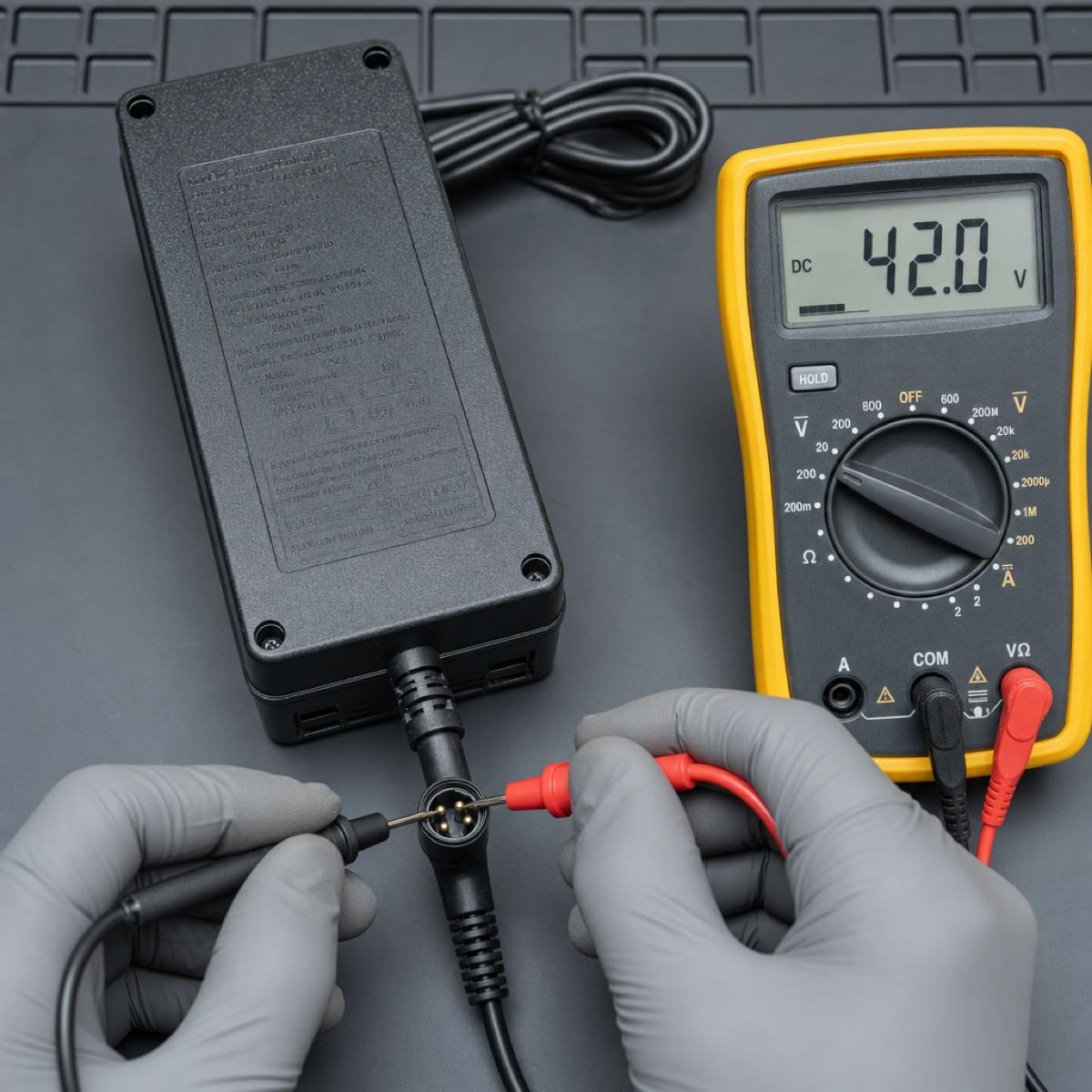
Read the DC OUTPUT voltage printed on the back of your original wall charger, then confirm polarity (+) and (−) on the isolated charger plug with a multimeter.
FAQ
Common Questions
How many watts of solar do I need to charge a 48V electric bike?
For a typical 20 km/day (12.4 mi/day) commute on a 48V e-bike like the Rad Power RadRunner 2 (672 Wh battery, ~9.3 Wh/km), our sizing model requires 60 W of minimum solar after derating — meaning a single 100 W solar panel in 4.5 peak sun hours recovers your daily ride in 2.8 hours with ~40% margin to spare. If you ride 40 km/day (25 mi/day) or want to recharge an empty 672 Wh pack in 1.7 sunny days, step up to 200 W (two 100 W panels wired in series).
Can a 100W solar panel charge an electric bike battery?
Yes, provided you pair it with a DC boost MPPT charge controller. In 4.5 peak sun hours, a 100 W panel delivers roughly 294 Wh of usable energy to the battery after accounting for the 0.70 real-world panel derate, 95% boost MPPT efficiency, and ~1.7% cable loss. That adds ~31 to 42 km (19 to 26 miles) of range per sunny day on a 48V commuter e-bike.
Why can't I use a normal 12V/24V solar controller on an e-bike?
Most portable 100 W–200 W solar panels operate at an optimum voltage (Vmp) of 18 V to 20 V DC, while 36 V, 48 V, and 52 V e-bike batteries require 42.0 V, 54.6 V, or 58.8 V DC to reach full charge. Standard RV/marine MPPT and PWM controllers are buck (step-down) regulators: they only work when the solar panel voltage is higher than the battery voltage. An e-bike requires a boost (step-up) MPPT controller that steps 18 V–36 V panel power up to your battery's constant-voltage (CV) ceiling.
Is it better to charge an e-bike directly from solar or through a portable power station (Jackery / EcoFlow)?
Direct DC solar charging is ~20–25% more efficient and far cheaper. When you charge a portable power station from solar (DC-to-DC), turn on its 120V/230V AC inverter (DC-to-AC), and plug in your e-bike's black AC charger brick (AC-to-DC), three conversion stages lose 25–28% of your solar harvest — and you pay $300–$600 for a second lithium battery you don't need because your e-bike already has one.
How do I know what voltage to set on a boost MPPT controller?
Never copy a voltage setting from a blog post or table. Read the DC OUTPUT specification printed on your own e-bike's original OEM AC wall charger nameplate (or confirm with the battery manufacturer), and verify the OEM charger's actual DC output voltage and pin polarity with a digital multimeter before connecting anything.
Can I charge my e-bike while riding with a solar panel mounted on a rack or trailer?
For daily commuters, stationary charging (propping a folding panel at work/home or mounting a rigid panel on a shed, balcony, or carport) is simpler, safer, and harvests 30–50% more energy per watt than a flat panel vibrating in street shade. Many e-bike Battery Management Systems (BMS) also disable the motor controller while the charge port is active.
Reference Table · Sun Hours by Daily Distance
Sunshine Hours Needed by Daily Ride Distance
| Vehicle | Battery | 10 km/day | 20 km/day | 30 km/day | 40 km/day |
|---|---|---|---|---|---|
| Rad Power RadRunner 2 48V Utility / Cargo E-Bike | 672 Wh 48 V (9.3 Wh/km) | 100 W 1.4 hrs sun | 100 W 2.8 hrs sun | 100 W 4.3 hrs sun | 140 W 4.1 hrs sun |
| Lectric XP 3.0 48V Folding Commuter E-Bike | 499 Wh 48 V (6.9 Wh/km) | 100 W 1.1 hrs sun | 100 W 2.1 hrs sun | 100 W 3.2 hrs sun | 100 W 4.2 hrs sun |
| Aventon Aventure 2 48V Fat-Tire Cruiser E-Bike | 720 Wh 48 V (7.5 Wh/km) | 100 W 1.1 hrs sun | 100 W 2.3 hrs sun | 100 W 3.4 hrs sun | 140 W 3.3 hrs sun |
| Sur-Ron Light Bee X 60V Off-Road Electric Moped / Bike | 2400 Wh 60 V (32 Wh/km) | 140 W 3.5 hrs sun | 280 W 3.4 hrs sun | 400 W 3.6 hrs sun | 400 W 4.8 hrs sun |
Ready to Price Your Solar Kit and Payoff Period?
Pick your e-bike or scooter, choose foldable or rigid panels, and get your complete parts list in seconds.