
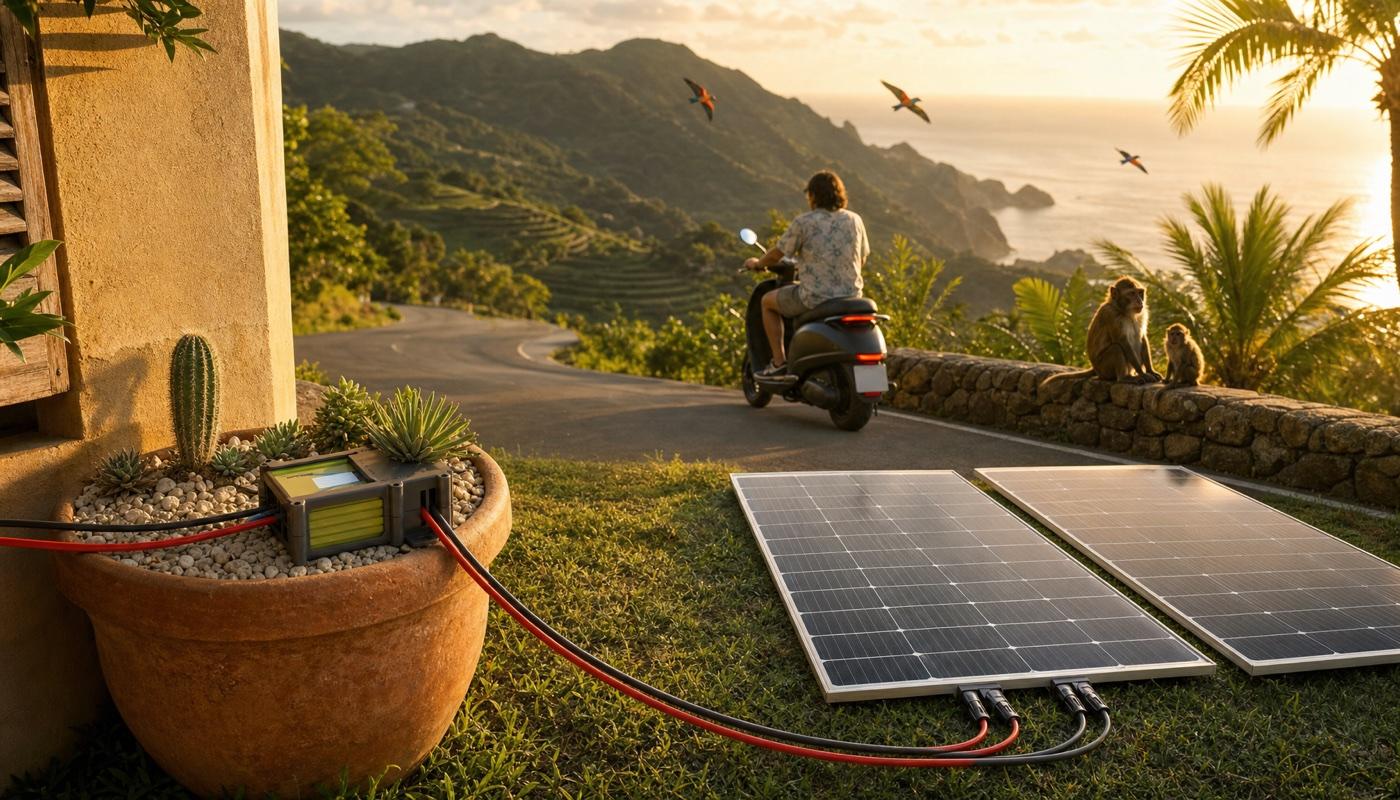

Sur-Ron Hyper Bee
- Battery
- 58.08 V · 22 Ah1,278 Wh · NMC
- Top speed
- 64 km/h
- Range
- 56 km
- Consumption
- 22.8 Wh/kmestimated
Can You Solar Charge a Sur-Ron Hyper Bee?
No DC port · Charges through its own 382 W charger · 500 W station
A 560 W solar array (4 panels) charges a power station, and the station's AC outlet feeds the Sur-Ron Hyper Bee's own charger (382 W at 120 V) through its Sur-Ron Hyper Bee magnetic port inlet. A 51 km day (~1163 Wh) is recovered in about 4.2 sun hours (4.5 sun hours/day market average). There is no separate MPPT and no charge voltage for us to recommend — the vehicle's charger owns the battery.

560 W Solar Array
4 × 140 W (2S2P)
500 W Station AC
for a 382 W charger at 120 V
~4.2 hrs sun for 51 km
Daily 51 km commute recovery
Similar vehicles & kit parts
Riders also viewed
- Aventura-X EV3072 V · 2.9 kWh200 W kit · GX16 aviation plug
 EV
- BMW CE 04148 V · 8.9 kWh450 W kit · Type 2 AC (J1772 in the US)
 EV
- EMOVE RoadRunner V348 V · 1.1 kWh100 W kit · XLR 3-pin
 EV
- Heybike Mars 3.048 V · 0.6 kWh50 W kit · DC 5.5 x 2.5 mm barrel (DC5525)
 EV
- Part560W solar array — 4 × 140W solar panels as 2 parallel strings of 2 in series (2S2P)Kit part
- DC cable, panel to station — 4mm² min · 5.26mm² suppliedKit part
 Part
- MultimeterKit part
 Part
2 · Kit Cost, Payoff Period & What the Station Must Do
Should You Solar Charge Your Sur-Ron Hyper Bee?
Let's consider the important factors — upfront kit cost, payback against buying gas and wall electricity, total cost of ownership, air and noise pollution, and local legal rules in United States — so you can decide for yourself.
How much does a station kit for a Sur-Ron Hyper Bee cost?
A complete station kit for the Sur-Ron Hyper Bee costs $1,364 (a PECRON E2000LFP, 4 × 140 W panels, the panel-to-station cable) — this is not an MPPT kit: the station supplies a mains socket and the vehicle's own charger does the rest.
Will You Save Money over Gas?
10-Year Cumulative Fuel Savings — Sur-Ron Hyper Bee
~3.5 yrs
Payoff breakeven vs. buying gas (~$367/yr)
~15.2 yrs
Payoff breakeven vs. wall outlet (~$90/yr)
+$3,042
Net profit vs. gas by Year 10 ($1,078 in grid kWh avoided)
Is a solar-charged Sur-Ron Hyper Bee really cheaper than petrol?

Sur-Ron Hyper Bee + Solar
1.28 kWh NMC · 64 km/h · 56 km range
$4,564/5 yrs
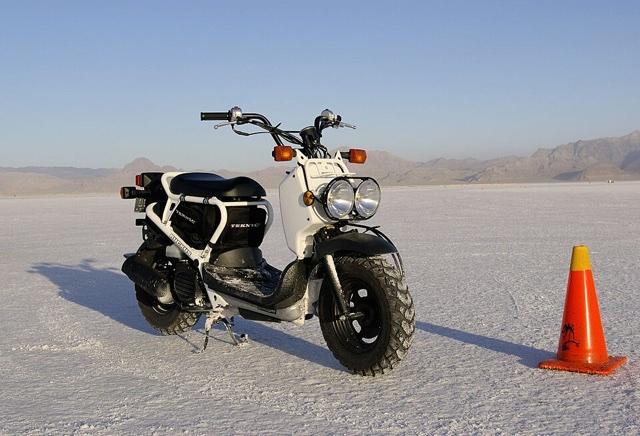
Honda Ruckus 49cc (Gas)
49cc · 47.6 km/L · 64 km/h
$2,527/5 yrs
What the station has to be able to do
Charger load
The station's AC output must be 1.25× the charger's draw
A charger is a switch-mode load: it pulls a surge at start-up, so a station sized exactly to the wattage will trip even though the numbers look right. Beyond AC output, the station must bank 1300 Wh for a day's riding and its solar input must accept the 560 W array — that input is usually the number that actually binds.
A floating neutral is why a station refuses a vehicle
The vehicle's charging cable checks for a neutral-to-ground path before it closes its relay. A station whose output floats reads as a ground fault, and the charge never starts even though the station is running. Only two fixes are legitimate: a unit bonded at the factory, or the station maker's own grounding adapter — model-specific, never universal.
The requirement: 500 W of AC output, 1300 Wh of capacity, and a solar input for the 560 W array.
Will Solar-Charging a Sur-Ron Hyper Bee Reduce Air Pollution (CO₂ & PM2.5)?
In United States, the utility power grid averages 380 g CO₂/kWh (16% coal/fossil share). Charging your Sur-Ron Hyper Bee directly from solar eliminates both tailpipe exhaust and power-plant smokestack emissions:
Carbon Emissions per Kilometer (g CO₂/km)
Breathable PM2.5 Air Particles (mg PM2.5/km)
Sources: US EPA eGRID National Average (~380 gCO2/kWh); EMEP/EEA Two-Wheeler Emission Inventory & IPCC AR6.
Will Driving a Solar-Charged Sur-Ron Hyper Bee Reduce Noise Pollution?
Decibels (dBA) are logarithmic: every +10 dB sounds twice as loud to the human ear. The Sur-Ron Hyper Bee's brushless electric motor cuts city pass-by noise by 23 dBA (~80% quieter) compared to a 125cc gas scooter, and solar-charges at 0 dBA:
Is It Legal to Solar-Charge a Sur-Ron Hyper Bee in United States?
Relevant authority: local utility interconnection rules & your vehicle's road registration
Utility interconnection agreements and roof-solar permits apply to AC photovoltaic systems wired into a home's breaker panel. A portable power station charged by ground- or balcony-mounted panels is a standalone appliance: it never exports to the grid, so there is nothing to interconnect. Two questions stay separate — whether the panel and station need approval (they do not), and whether the vehicle may be ridden on public roads, which is that vehicle's own registration question and is not changed by charging it from the sun.
- No utility interconnection: the station is charged from panels and never exports power.
- No roof work: ground, balcony or carport placement avoids the roof work that usually triggers a permit.
- Road legality belongs to the vehicle: solar charging changes neither its registration, its insurance, nor where it may be ridden.
Ride more or less than 51 km/day? Adjust your daily distance, panel placement and cable runs for the Sur-Ron Hyper Bee:
Size Your Hyper Bee Station Kit →2a · Head-to-head
How does it compare to popular EVs?
Bars are scaled to the highest value in this group. Cost per km = vehicle price + its solar kit + upkeep, over the same distance for every row (51 km/day for 5 or 10 years); a model with no solar kit pays for grid energy instead. Prices are this market's own figures, shown in your display currency.
Price
new vehicle price- Sur-Ron Hyper BeeThis model
- $3,050
- NIU XQi3 Street
- $3,999
- Talaria Sting R MX4
- $4,000
- Sur-Ron Light Bee X
- $4,500
- Sur-Ron Light Bee X 10kW
- $4,700
Top Speed
- Sur-Ron Hyper BeeThis model
- 64 km/h
- NIU XQi3 Street
- 75 km/h
- Talaria Sting R MX4
- —
- Sur-Ron Light Bee X
- 75 km/h
- Sur-Ron Light Bee X 10kW
- 80 km/h
Range
- Sur-Ron Hyper BeeThis model
- 56 km
- NIU XQi3 Street
- 64 km
- Talaria Sting R MX4
- 100 km
- Sur-Ron Light Bee X
- 75 km
- Sur-Ron Light Bee X 10kW
- 75 km
Battery Size
- Sur-Ron Hyper BeeThis model
- 1.3 kWh
- NIU XQi3 Street
- 2.3 kWh
- Talaria Sting R MX4
- 2.6 kWh
- Sur-Ron Light Bee X
- 2.4 kWh
- Sur-Ron Light Bee X 10kW
- 2.5 kWh
Motor Wattage
- Sur-Ron Hyper BeeThis model
- 8 kW
- NIU XQi3 Street
- 3.5 kW
- Talaria Sting R MX4
- 6 kW
- Sur-Ron Light Bee X
- 8 kW
- Sur-Ron Light Bee X 10kW
- 10 kW
Solar Chargeable
— = no plug on record yet- DC charging
- AC charging
- Sur-Ron Hyper BeeThis model
- DC charging: No
- AC charging: Yes
- NIU XQi3 Street
- DC charging: No
- AC charging: Yes
- Talaria Sting R MX4
- DC charging: No
- AC charging: Yes
- Sur-Ron Light Bee X
- DC charging: Yes
- AC charging: Yes
- Sur-Ron Light Bee X 10kW
- DC charging: No
- AC charging: Yes
Cost per km (5 years)
incl. vehicle + kit + upkeep- Sur-Ron Hyper BeeThis model
- $0.05/km
- NIU XQi3 Street
- $0.07/km
- Talaria Sting R MX4
- $0.06/km
- Sur-Ron Light Bee X
- $0.06/km
- Sur-Ron Light Bee X 10kW
- $0.07/km
Cost per km (10 years)
incl. vehicle + kit + upkeep- Sur-Ron Hyper BeeThis model
- $0.03/km
- NIU XQi3 Street
- $0.03/km
- Talaria Sting R MX4
- $0.03/km
- Sur-Ron Light Bee X
- $0.03/km
- Sur-Ron Light Bee X 10kW
- $0.04/km
Compare them side by side, attribute by attribute →
3 · Station Kit Parts for Sur-Ron Hyper Bee
What do you need to solar charge a Sur-Ron Hyper Bee?
Click any part below to open the full parts list with safety disclaimers & live retailer links, or adjust your daily distance and cable runs in the free kit configurator. There is no MPPT controller in this list: a station's solar input is already an MPPT, and a second controller cannot be wired into it.
1 m1× 1×
 1×
 1×
 Optional
 Optional
 Optional
Estimated core kit total: $1,364
See per-item pricing, electrical safety disclaimers, and direct local retailer links on the full parts list page.
Solar array → the station's solar input
The 560 W array (4 panels) feeds the station's solar input, not the vehicle. That input is already an MPPT with its own Voc window — it is the only voltage ceiling on this path.
The station banks the day's energy
The station holds 1300 Wh — about one day's riding. The pattern is accumulate-then-dump: the array fills the station through the day and the vehicle takes it in one or two sessions.
The station's AC outlet → the vehicle's own charger
The vehicle's own 382 W charger plugs into the station's AC output. That charger owns the voltage and current the pack sees, so there is no setting for you to enter.
The AC output's neutral must be bonded
The charging cable checks for a neutral-to-ground path before closing its relay. A floating station is rejected as a ground fault, so a factory-bonded unit or its maker's grounding adapter is a purchase requirement, not an extra.
4 · Safe Charging Order & Recorded Charger Specs
How to Charge a Sur-Ron Hyper Bee With Free Solar Power
To charge a Sur-Ron Hyper Bee from sunlight, the 560 W array charges a power station, and the station feeds the vehicle's own charger through its Sur-Ron Hyper Bee magnetic port inlet. The order matters: array first, station second, vehicle last — so the AC outlet is never live before its neutral is bonded.
1 · Measure the array's Voc in sun & land it on the station's solar input
Wire the 4 panels to the configuration the plan computed (2S2P) and check the string's open-circuit voltage with your meter. Never exceed the station's solar-input Voc limit (95 V) — its input is usually not MC4, so an adapter cable may be needed.
2 · Power the station and confirm its AC output is pure sine
Power the station from solar and confirm no fault code. The output must be pure sine: a modified-sine inverter will make the charger buzz or trip. Check too that the outlet can deliver at least 500 W.
3 · Bond the outlet's neutral before the vehicle is plugged in
Fit the station maker's grounding adapter first (they are model-specific), then plug the vehicle's cable into the AC outlet. Without this step the cable reads a ground fault and never closes its relay.
4 · Plug in the vehicle's own cable and watch the dash
Use the Sur-Ron Hyper Bee's own charging cable. The vehicle's charger starts the session, so the numbers to watch are on the dash and on the station's output load. After ten minutes the battery percentage must be rising.
Recorded Sur-Ron Hyper Bee Charger & Inlet Specs
The table lists the battery architecture, the built-in charger's draw at this market's mains, and the inlet's verification status. We never recommend a charge voltage — the vehicle's own charger decides it.
| Nominal Voltage | 58.08 V |
|---|---|
| Pack Capacity | 1,278 Wh (22 Ah) |
| Battery Chemistry | NMC (removable) |
| Built-in Charger at 120 V | 382 W |
| Vehicle Inlet | Sur-Ron Hyper Bee magnetic port |
| Station Class | 500 W minimum AC output · 1300 Wh capacity · 550 W solar input |
| Neutral Bond | Not established |
Recorded Data Sources
- https://sur-ron.co.uk/hyper-bee-8kw-my26/ — Sur-Ron UK MY26: 8 kW, 40 mph, 39 kg, '58V 22Ah lithium-ion', 20–80% in around two hours, up to 35 miles at 25 mph.
- https://sur-ron.co.uk/wp-content/uploads/2026/08/Surron-Hyper-Bee-8kW-MY26-Owners-Manual.pdf — Hyper Bee 8kW MY26 owner's manual: 'Battery Type 58.08V/22Ah'; 'Magnetic Battery Charging Port'; schematic p.39 puts the charger on CAN-H/CAN-L to the BMS; 0–100% ~3.5 h; charge range 0–55 °C.
- https://b2b.sur-ron.co.nz/products/surron-hyper-bee-portable-charger-58-8v-6-5a-saa-mpc-21700-y026a-0400 — OEM charger 21700-Y026A-0400: 58.8 V / 6.5 A (382 W). The 20–80% time on a 1.28 kWh pack implies ~380 W average, which agrees.
- https://xmotorusa.com/collections/surron — US dealer listing, checked 2026-11-16: 'Surron Hyper Bee 8kW 2026' $3,050.
5 · Sur-Ron Hyper Bee Solar Charging FAQ & Distance Sizing
Sur-Ron Hyper Bee Solar Charging FAQ
Can you solar charge a Sur-Ron Hyper Bee?
Yes — but not through a DC kit. The Sur-Ron Hyper Bee has no DC charge port: its inlet is Sur-Ron Hyper Bee magnetic port and its charger is built into the vehicle (382 W at 120 V). The solar route is a power station into that charger: a 560 W array charges the station, the station's AC outlet feeds the vehicle's own cable, and a 51 km day (~1163 Wh) is recovered in about 4.2 sun hours.
How big a power station does the Sur-Ron Hyper Bee need?
Two numbers, and the larger one decides. Its AC output must carry the charger with 25% headroom — at least 500 W for a 382 W charger at 120 V. Its battery must bank a day's riding, so 1300 Wh. The station's solar input is usually the third limit: an array larger than that input is array the station cannot absorb.
Why can't an MPPT kit charge the Hyper Bee?
An MPPT kit feeds a two-wire DC port at pack voltage. The Sur-Ron Hyper Bee runs a 58.08 V pack (1,278 Wh), above the 75 V DC line, and it has no DC port to feed at all — its inlet is AC and the charger that talks to the battery is inside the vehicle. A kit would have nothing to plug into.
Why does my power station refuse to charge this scooter?
Because its AC output floats. The vehicle's charging cable reads the missing neutral-to-ground path as a ground fault and drops its relay, so the vehicle does not charge even though the station is running. The fix is the station maker's grounding adapter — model-specific, never universal — or a unit whose output is bonded from the factory. This is what makes most power stations refuse a vehicle.
Can I use the Hyper Bee's own charging cable from a power station?
Yes, as long as the station meets the numbers above. One constraint: a Sur-Ron Hyper Bee magnetic port cable cannot advertise less than 6 A, so the smallest load it can present is 0 W at 120 V — the station has to sustain that continuously, not just at start-up. Pure sine only; a modified-sine inverter will buzz or trip on this load.
How many panels to charge the whole pack in a day?
A full 1,278 Wh in one sunny day needs about 600 W of array — a far bigger number than the 560 W a 51 km/day commute needs. For daily riding the pattern is accumulate-then-dump: the array banks the day's energy in the station and the vehicle takes it in one or two sessions.
Can I charge while riding?
No. The system is designed for stationary daytime charging, with the panels in full sun and the station in ventilated shade. Many vehicle BMS units also inhibit throttle output while the charge inlet is active.
Sunshine Hours & Array Sizing by Daily Distance (10–40 km/day)
Computed from a consumption rate of 22.8 Wh/km, the AC path's conversion chain (station PV input × inverter × the vehicle's charger ≈ 70%), a 0.70 panel derating factor, and 4.5 peak sun hours/day in United States. The last column is the sun hours the array needs to put the day's energy back — when it exceeds the market's sun hours, this station does not close the day.
| Daily Distance | Daily Wh | Array (needed → bought) | Sun Hrs to Recover | 0–100% Full Pack |
|---|---|---|---|---|
| 10 km/day | 228 Wh | 150 W → 200 W (2 panels, 2S) | 2.3 hrs | 2.9 sunny days |
| 20 km/day | 456 Wh | 250 W → 280 W (2 panels, 2S) | 3.3 hrs | 2.1 sunny days |
| 30 km/day | 684 Wh | 350 W → 400 W (4 panels, 2S2P) | 3.5 hrs | 1.4 sunny days |
| 40 km/day | 912 Wh | 450 W → 600 W (6 panels, 3S2P) | 3.1 hrs | 1 sunny days |
| 51 km/day | 1163 Wh | 550 W → 560 W (4 panels, 2S2P) | 4.2 hrs | 1 sunny days |