
828 Million Gas Scooters Are Choking the World's Cities. Here Is the Maths.
Every city in the sun belt has the same argument: the scooters are choking us, so buy electric. The second half of that sentence is where the maths gets interesting, because an electric scooter is only as clean as the wire it is plugged into.
Summary
The world has 828,018,434 registered powered two- and three-wheelers, 81.3% of them in Asia. A 110–125 cc commuter riding 30 km a day emits 306.6 grams of PM2.5 and 679 kg of lifecycle CO2 in a year.
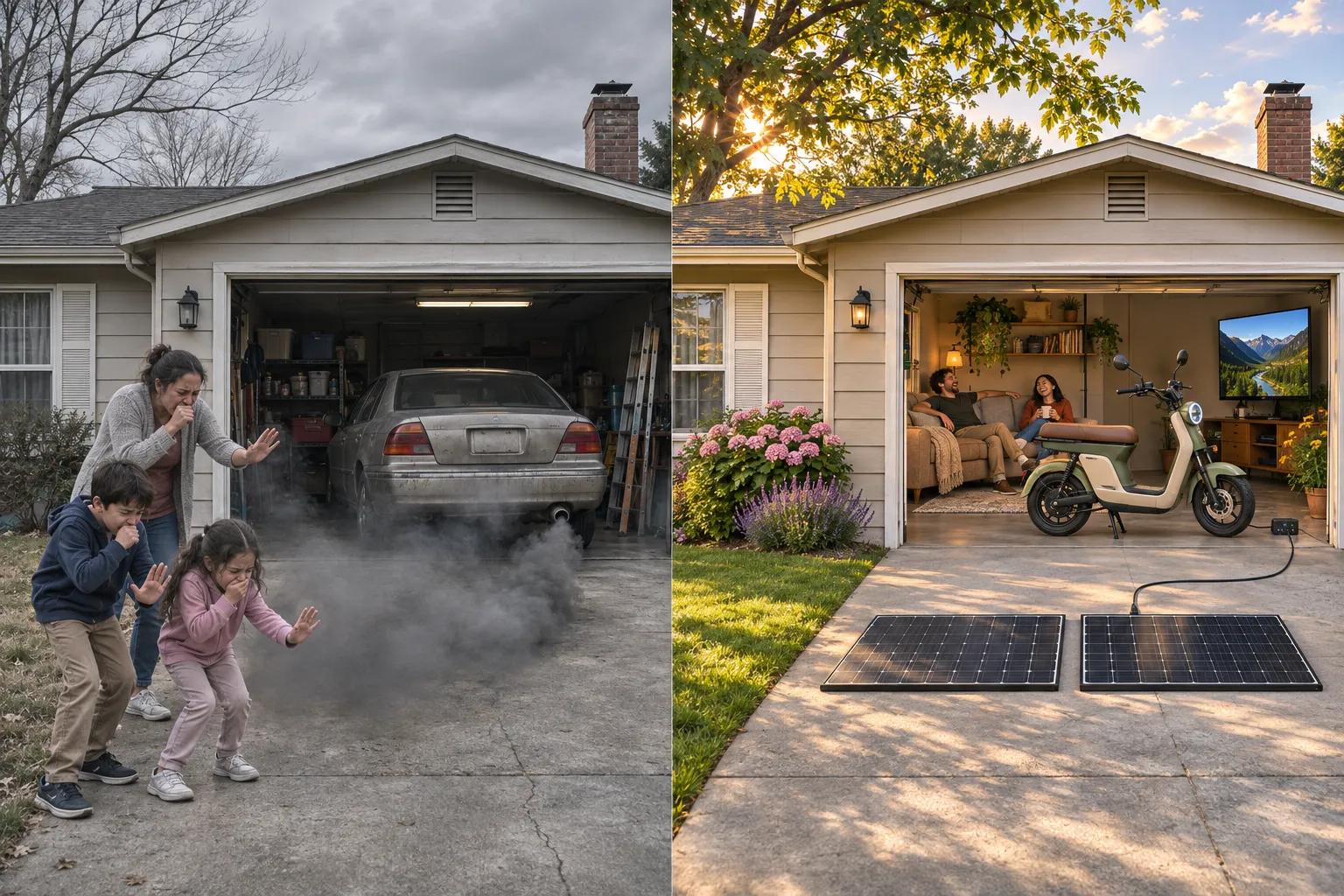
An electric scooter removes all of that from the street — but charged from a 62% coal grid it still carries 272 kg of CO2 and 67.5 grams of PM2.5 out of a power station. Charged from its own panels, the same ride is 11 kg of CO2 and no smokestack PM2.5 at all.
1 · The Fleet
828 Million Scooters: Where That Number Comes From
The world's registered powered two- and three-wheelers add up to 828,018,434 machines — about one for every ten people on Earth. 673,584,765 of them, 81.3% of the total, are in Asia.
The number is not a survey. It is a model built on the WHO Global Status Report on Road Safety 2023, which publishes each country's own registered count of powered two- and three-wheelers alongside its total road fleet. For the 85 countries that report both counts and more than half a million road vehicles, this page can rank the scooter share of the road. For a country that reports no count, the model fills the gap with its continent's two-wheelers-per-person rate, capped at one vehicle per person, because a registry can outlive the vehicles on it.
Two things follow from that, and both matter for the argument. First, the total is a registry figure, so it says nothing about how far those machines are ridden — that comes from a different dataset, the per-country daily distance every kit on this site is sized from. Second, the source is imperfect at the edges: 5 country profiles (Cyprus, Georgia, the Philippines, South Sudan, Chad) report a road fleet smaller than their own two-wheeler count, which cannot be true. They are excluded from the ranking rather than printed as a share above 100%.
| Region | Two/three-wheelers | Share of world fleet | 2-panel kit viable | Up to 4 panels viable |
|---|---|---|---|---|
| Asia | 673,584,765 | 81.3% | 22.6% | 64.5% |
| South America | 61,379,406 | 7.4% | 21.0% | 53.8% |
| Europe | 47,053,957 | 5.7% | 0.0% | 1.6% |
| North America | 23,584,215 | 2.8% | 18.7% | 47.8% |
| Africa | 20,454,656 | 2.5% | 35.5% | 71.9% |
| Oceania | 1,542,393 | 0.2% | 4.5% | 42.3% |
The share in the last two columns is the part of that region's riders whose parking space and worst-month sun pass the site's 2-panel and 4-panel tests. Europe's near-zero is latitude and roof space, not a lack of scooters.
Where the world's 828,018,434 two- and three-wheelers are
One more thing about that total, because it decides how big every fix below can be. 495,155,024 of those riders — 59.8% of the fleet — park somewhere with room for two to four panels and enough sun in the worst month of the year to make them work. 176,367,926 of them, 21.3%, need only two panels. That is the addressable market for the cheapest intervention on this page, and it is measured in hundreds of millions.
2 · One Rider, One Year
What One Petrol Scooter Puts Into the Air in a Year
An Indonesian commuter riding 30 km a day covers 10,950 km a year. On the EMEP/EEA and ICCT factors this site uses for a 110–125 cc four-stroke commuter, that is 240.9 litres of petrol, 306.6 grams of PM2.5, 15.33 kg of carbon monoxide, 1.97 kg of nitrogen oxides and 679 kg of lifecycle CO2.
Those figures are not a worst case. They are the ordinary numbers for the most common motor vehicle on Earth: a small automatic scooter, four-stroke, ridden at city speeds. PM2.5 is the part that reaches deep into the lungs, and the 28 mg per kilometre behind that 306.6 grams counts both what leaves the exhaust and what the brakes and tyres grind off the road. Under full throttle the same scooter is an 84 dBA event; at a steady 30 km/h it is 76 dBA.
Put the same ride on a 20 km global baseline — the distance this site sizes every kit from when a market has no figure of its own — and a year of riding is 204.4 grams of PM2.5 and 453 kg of CO2. Smaller, but the same order, and multiplied by hundreds of millions of machines it is why a city's air quality tracks its scooter count.
| One rider, one year | Petrol scooter | Coal-grid electric | Solar-charged electric |
|---|---|---|---|
| Street PM2.5 (exhaust) | 306.6 g | 0 g | 0 g |
| Street PM2.5 (brake & tyre wear) | included above | 38.3 g | 38.3 g |
| Power-station PM2.5 | 0 g | 67.5 g | 0 g |
| Lifecycle CO2 | 679 kg | 272 kg | 11 kg |
| Street noise at 30 km/h | 76 dBA | 53 dBA | 53 dBA |
| Fuel or electricity a year | 240.9 L petrol | 365 kWh | none |
The same 10,950 km, three ways. The petrol column's PM2.5 includes brake and tyre wear, which is why the electric columns still show a wear figure beside a zero exhaust figure. Nothing here is added across columns: street and smokestack PM2.5 are different problems in different places.
Carbon monoxide and nitrogen oxides are the other half of the street story. 15.33 kg of CO and 1.97 kg of NOx a year from one scooter sounds small until it is multiplied by the 121,602,401 machines Indonesia alone has registered — and NOx is the precursor that turns into the ozone and secondary particles that make an afternoon in Jakarta feel the way it does.
To see what the same daily distance needs in panels and a controller for a specific scooter, size a kit in the solar kit builder.
3 · The Coal Trap
Why Plugging In Is Not the Whole Answer
An electric scooter has no exhaust, so its street PM2.5 is zero and it is 23 dB quieter — about 79.7% less loud to the ear. But the electricity still has to be made. On Indonesia's grid, at 62% coal and 745 gCO2/kWh, a year of riding carries about 272 kg of CO2 and 67.5 grams of PM2.5 out of a chimney.
That is still a large improvement on petrol: 59.9% less lifecycle CO2 for the same ride, and every gram of the particulate moves from the street where people breathe it to a power station that, in principle, has a scrubber. It is also nothing like as good as it looks in an advert, and the gap between those two statements is where most of the public argument about electric scooters goes wrong.
Nor is Indonesia an outlier. On the world-average grid this dataset uses as its fallback, the 20 km baseline carries 116 kg of CO2 a year — against 7.3 kg on the same panels. Wherever the grid is dirtier than the sun, the wire decides the result.
Lifecycle CO2 for the same 10,950 km: petrol, coal-grid, and solar
The arithmetic is short enough to do on the back of an envelope. The scooter needs 33.3 Wh at the socket for every kilometre, because the battery takes 30 Wh/km and the wall brick loses about a tenth of what it draws. Multiply by 745 grams of CO2 per kilowatt-hour and the grid has already decided the answer before the scooter's motor is chosen. A cleaner grid moves that bar; a bigger battery does not.
This is also why the coal-grid bar is not the failure the headline suggests. On the worst grid in this dataset an electric scooter still beats a petrol one on CO2 by a wide margin, and beats it completely on street particulate. The failure is pretending the two are equivalent, or that the electric one is free.
4 · The Sun Belt
The 495 Million Riders Who Could Charge From Their Own Roof
59.8% of the world's two- and three-wheelers — 495,155,024 machines — park somewhere with room for two to four panels and enough sun in the worst month of the year. 21.3% of the fleet, 176,367,926 riders, need only two panels.
Those shares are not a guess about behaviour. They are a geometric test: NASA POWER's worst-month irradiance for the rider's own coordinates, the daily energy a 30 km ride needs, and how much of a roof, yard or balcony the model assumes that rider has. A rider passes the two-panel test if two 100 W panels, derated for real-world output, cover the day in the worst month of the year.
| Country | Two/three-wheelers | Share of all road vehicles | Daily distance | Peak sun hours |
|---|---|---|---|---|
| Viet Nam | 70,113,559 | 93.0% | 19 km | 4.6 h |
| Indonesia | 121,602,401 | 82.7% | 30 km | 4.8 h |
| Bangladesh | 3,822,446 | 76.2% | 30 km | 4.7 h |
| India | 243,683,000 | 74.7% | 35 km | 5.4 h |
| Thailand | 21,864,326 | 51.7% | 35 km | 5.0 h |
| Brazil | 30,252,020 | 27.1% | 30 km | 5.0 h |
| Italy | 10,372,343 | 18.7% | 30 km | 4.6 h |
| United States | 8,347,435 | 3.0% | 51 km | 4.5 h |
Registered two- and three-wheelers as a share of every registered road vehicle, with the daily distance and worst-month sun hours the site sizes a kit from. The Philippines and Taiwan are deliberately absent: the Philippine profile's total road fleet is not a usable count, and Taiwan has no profile in this dataset.
Read the two columns together and the ranking that follows almost writes itself. The countries where scooters are most of the road fleet are the countries with the most sun and the least grid headroom. Vietnam, at 93.0%, is the extreme case; Indonesia, with 121,602,401 machines at 82.7% of the road, is the biggest single addressable fleet in the world. Neither of them needs a new power station to clean up its scooters. Both of them have roofs.
What they do not all have is a two-wire charge port. A kit can only feed a port that accepts plain DC: a scooter whose charger is built in, or whose battery wants a data handshake before it opens, has to go through a power station and its own AC charger instead.
We record which charge port each model uses, and whether a DC kit can feed it, in the electric vehicle catalogue.
5 · The Ranking
Five Fixes, Ranked by What They Actually Remove
Ranked from least to most effective per rider and per dollar: electric cars, tighter exhaust standards, grid-charged electric scooters, e-bikes replacing short car trips, and off-grid solar kits for the light EVs people already own.
The ranking is not a taste judgement, and it is not a claim that the bottom of the list is useless. It is what happens when each intervention is scored on the same three axes — street PM2.5 removed, lifecycle CO2 removed, and whether it needs the grid to change before it works — against the petrol scooter it displaces.
| Fix | Upfront cost per rider | Street PM2.5 | Lifecycle CO2 | Noise | Needs grid upgrade |
|---|---|---|---|---|---|
| 5 · Electric cars | US$35,000–50,000 | −100% exhaust | not quantified here | not scored | Yes — fully |
| 4 · Euro 5 / BS-VI exhaust rules | US$0 to the rider | no measured factor | no change | not scored | No |
| 3 · Grid-charged e-scooters + swap cabinets | from US$1,399 | −100% street; 67.5 g smokestack | −59.9% | −79.7% | Yes — fully |
| 2 · E-bikes for short car trips | from US$799 | −100% exhaust | −96.5% vs scooter | −79.7% | Partly |
| 1 · Off-grid solar kits | US$85–140 | −100% street; 0 smokestack | −98.4% | −79.7% | No — none at all |
Every cut is against the 110–125 cc petrol scooter on the same annual distance. Two cells read 'not quantified here' because this dataset holds no car records and no measured Euro 5 / BS-VI two-wheeler PM factor — a dash is more honest than a number we cannot derive.
Start at the bottom, because that is where the money is. An electric car replaces one scooter with a machine that costs more than a hundred times what the solar kit at the other end of this table costs, and it does not remove a single gram of street PM2.5 that an 85-dollar solar kit would not. It is the right answer for a family, and a poor answer for a city with 121,602,401 scooters.
Tighter exhaust standards are free to the rider and they do work — on new vehicles. They do nothing about the 828,018,434 machines already on the road, and this dataset holds no measured Euro 5 or BS-VI particulate factor for two-wheelers, so the table prints a dash rather than an invented percentage.
The grid-charged electric scooter is the option most cities actually pursue, and it is a real improvement: 59.9% less lifecycle CO2 and no street exhaust at all. Its weakness is written into the table — 67.5 grams of smokestack PM2.5 a year per rider on a 62% coal grid, and a hard dependency on that grid getting cleaner.
E-bikes are the sleeper. A 799-dollar e-bike at five to ten watt-hours per kilometre replaces a car trip with something a household can charge from a wall socket, and it needs no new grid capacity to do it. Its CO2 cut is measured against the scooter here because the car it displaces is not in this dataset, and it is still 96.5% below the scooter before the car enters the comparison.
The solar kit wins because it is the only row that needs nothing from the grid. It removes the street exhaust, removes the smokestack, and pays for itself out of the petrol it displaces in about 0.9 years for a 30 km-a-day rider in Indonesia.
6 · What It Costs
The Cheapest Fix on the List Is the One You Can Install Today
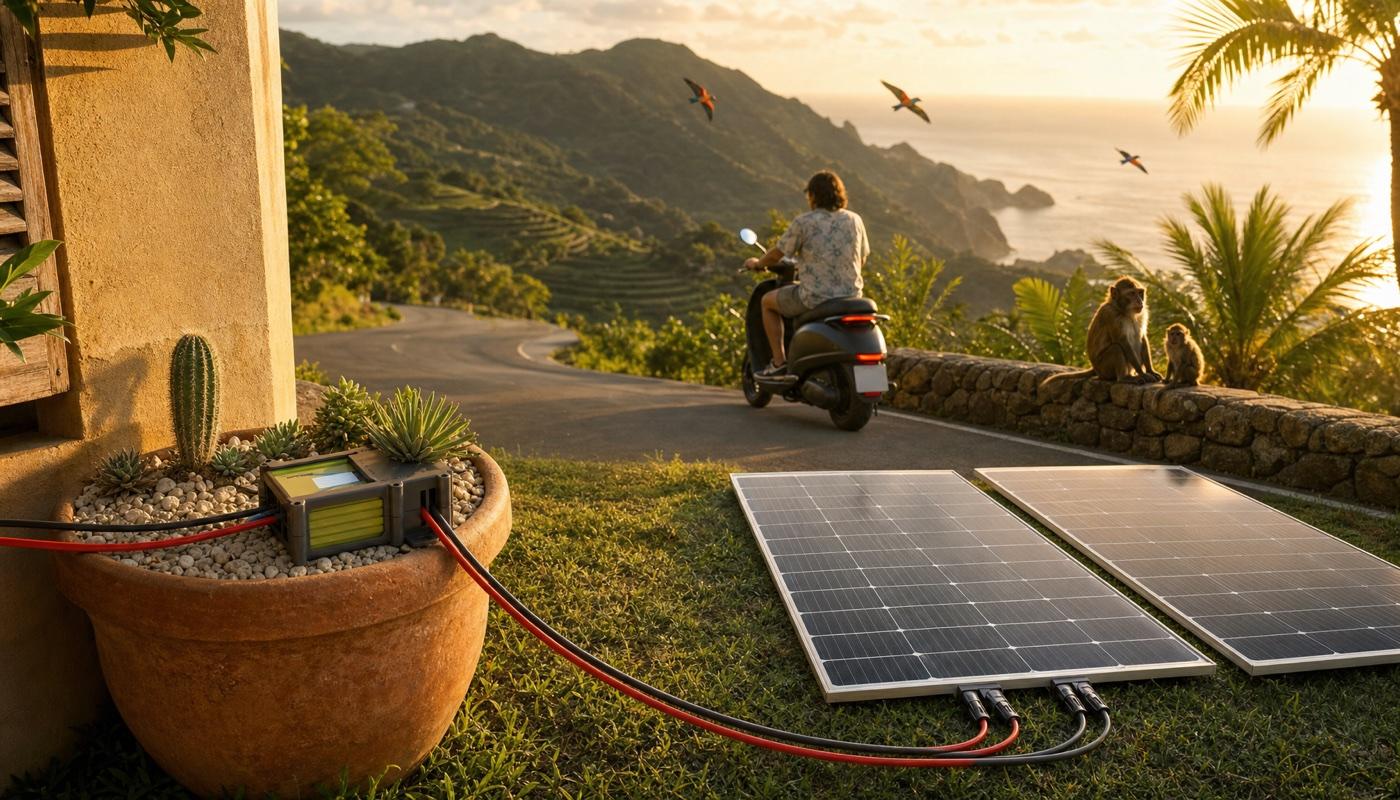
Two 100 W panels, a boost MPPT controller and PV cable come to about Rp 2,211,244 in Indonesia — roughly US$140 — and about ฿3,072 (US$85) in Thailand. No extra battery: the scooter already carries one.
That is the whole kit, minus the adapter that mates your particular charge port, which is priced per model because every brand uses a different plug. It is also the only intervention on the list that a rider can buy without waiting for a government, a utility or a manufacturer to do anything.
Two ways to charge the same scooter, and what each one costs the grid
Direct DC solar (2-wire DC port)
11 kg CO2 a year, no smokestack, no grid load
AC power-station path (built-in charger)
the universal fallback, at ~25% conversion loss
One warning before anyone buys anything, and it is the same one every guide on this site gives. The controller's output has to match the DC voltage printed on the nameplate of the charger that came with your scooter, verified by measuring that charger's plug with a multimeter. We do not publish a voltage to set, because the right number belongs to your scooter and not to a webpage. If your port needs a data handshake or your charger is built into the deck, the solar route is a power station into that charger, not a kit into the port.
And keep the wall charger. A commuter kit is sized to put back a day's riding on a sunny afternoon, not to refill an empty pack in a monsoon week. What the sun replaces is the ordinary daily charge; what it does not replace is the socket.
Not sure what your own scooter needs? Take the 60-second savings and solar fit quiz. It asks a few questions about your scooter, your daily distance and your parking, then prices the panels and the controller for your own roof and your own sun hours.
FAQ
Common Questions
How many gas scooters are there in the world?
About 828,018,434 registered powered two- and three-wheelers. That is a model built from the WHO Global Status Report on Road Safety 2023, whose country profiles each report their own registered count: 673,584,765 of them — 81.3% of the world fleet — are in Asia. A country that reports no count is filled in at its continent's two-wheelers-per-person rate, capped at one vehicle per person, so the figure is an estimate of a registry total rather than a census.
How much PM2.5 does one petrol scooter produce in a year?
On the EMEP/EEA and ICCT factors this dataset uses, a 110–125 cc four-stroke commuter scooter emits 28 mg of PM2.5 per kilometre, counting exhaust plus brake and tyre wear. A 30 km-a-day rider covers 10,950 km in a year, which is 306.6 grams of PM2.5 — plus 15.33 kg of carbon monoxide, 1.97 kg of nitrogen oxides and 679 kg of lifecycle CO2.
Are electric scooters really zero-emission?
At street level, yes: there is no exhaust, so the tailpipe PM2.5 is zero and the scooter is 23 dB quieter than the petrol one. But the electricity has to come from somewhere. On Indonesia's grid — 62% coal at 745 gCO2/kWh — a year of riding still carries about 272 kg of CO2 and 67.5 grams of PM2.5 out of a power station chimney. Charged from its own panels instead, the same ride is about 11 kg of CO2 and no smokestack PM2.5 at all.
Is a solar kit cheaper than petrol for a scooter?
For a 30 km-a-day rider in Indonesia it is. Petrol for that riding costs about Rp 2,409,000 a year, and the panels, boost controller and cable for a two-panel kit are listed at about Rp 2,211,244 — under a year of fuel. The catch is that the kit is one payment up front, and it only replaces the sunniest part of your charging: keep the wall charger for deep recharges and rainy weeks.
Which country has the highest share of scooters on its roads?
Viet Nam, where 93.0% of all registered road vehicles are powered two- or three-wheelers — 70,113,559 of them. Indonesia is next at 82.7% (121,602,401 machines), with Myanmar and Pakistan close behind, then Bangladesh at 76.2%, India at 74.7% and Thailand at 51.7%. India has the largest fleet in absolute terms at 243,683,000. For contrast, the United States is at 3.0% and Italy at 18.7%.
What do I need to charge my scooter from solar panels?
Two panels, a boost (step-up) MPPT controller, PV cable and an adapter that mates your charge port — and no extra battery, because the scooter already carries one. The controller is a DC-DC converter, not a replacement charger: its output has to match the DC voltage printed on your own OEM charger's nameplate, verified by measuring that charger's plug with a multimeter. If the port needs a data handshake or has a charger built into the vehicle, the solar route is a power station into that vehicle's own charger instead.
Ready to Price Your Solar Kit and Payoff Period?
Pick your e-bike or scooter, choose foldable or rigid panels, and get your complete parts list in seconds.