US Market Hub · 4.5 Peak Sun Hours/DayBahasa Indonesia (Hub ID) →

Is a Solar Panel for an Electric Bike Worth It? Real Watts, Cost & Payback

The short answer: A 140 W direct DC solar kit (~$380) recovers a 51 km/day ride on a 48V commuter e-bike in ~4 sun hours (at the US average of 4.5 peak sun hours/day), and pays for itself in about 1.1 years against the petrol a 125 cc gas scooter burns over the same distance.

A 400 W 2S kit (~$651) covers a 60V off-road e-moto like the Sur-Ron Light Bee X for a 51 km day. Solar charging pays for itself on Day 1 against a $2,000 electrician quote for an off-grid shed or carport, in under 1 year against a camp gas generator, and in 3.5–5.5 years against California utility rates — while avoiding the 25–28% inverter loss of a $500 portable power station.

100 W – 200 W

100 W for 48V commuter e-bikes · 200 W (2S) for 60V e-motos & 40 km/day

~$380–$651

Complete direct DC kit (panel + boost MPPT converter + MC4 lead + bike plug)

Day 1 to <1 Yr

Day 1 vs $2,000 shed wiring · <1 yr vs camp gas generator · 3.5–5.5 yrs in CA

1 · Interactive Commute & Payback Calculator

Calculate your exact solar watts, charge time, kit cost & payback

Pick your vehicle class (48V E-Bike vs 60V–72V Scooter / E-Moto) and daily riding distance (10–40 km/day). Every figure below is computed by computeKitPlan using real 0.70 panel derating, DC-DC boost converter efficiency, cable drop, and 4.5 US peak sun hours.

1. Select Vehicle Class

Recommended Solar Array

140 W

1 × 140W (1S) · Min. need 130W (362 Wh/day)

Recovery Time (4.5h US Sun)

~4 hrs

Out of 4.5 peak sun hrs/day · 95.5% boost MPPT eff.

Estimated Complete Kit

$380

Solar panel(s) + boost MPPT converter + 4 mm² MC4 cable + bike plug

Payback Horizon

< 1 yr off-grid

< 1 yr vs camp generator · Day 1 vs $2k shed wiring · ~6.7 yrs on CA grid

Reference model: Rad Power RadRunner 2 (48V 672 Wh) (7.1 Wh/km). Want to pick your exact vehicle model and customize cable run lengths?

Open Full Solar Kit Builder →

US Grid & Off-Grid Economics · Three Distinct Comparisons

When does a solar e-bike kit actually pay for itself in the US?

Most solar calculators conflate the money saved by riding an e-bike instead of a car with the money saved by the solar panel itself. In the US, there are three completely different economic cases — and only one of them is weak.

Comparison #1 · No Outlet Available

Off-grid sheds, detached carports & apartments (~$380–$651 kit vs $2,000 electrician)

If your e-bike lives in a backyard shed, detached garage, carport, storage unit, or van with no 120V AC receptacle, trenching conduit and pulling a new circuit costs $1,200–$2,500+. A 140 W–400 W direct DC solar kit (~$380–$651) mounts or props in the sun and feeds your battery's 2-wire DC port directly — paying for itself on day one.

~$380–$651 vs $2,000

Instant day-1 savings when your shed, carport, or camp spot has no AC socket

Comparison #2 · Off-Grid vs Gas Generator

Beating a loud gas inverter generator at camp or trailheads (<1 year payback)

Off-grid riders charging a 48V fat-tire e-bike or 60V Sur-Ron Light Bee X from a 2200 W gas inverter generator burn ~0.1 gal/hr for the 4–6.5 hours an OEM charger runs — roughly 0.5–0.65 gallons ($2.50–$3.90 of fuel) per charge, plus noise and fumes. Against daily or frequent generator charging, a ~$380–$651 silent solar kit pays back in under a year.

< 1 Year Payback

Replaces ~$2.50–$3.90 of generator fuel per charge cycle with silent DC sunshine

Comparison #3 · Direct DC vs Power Station & Wall Grid

Avoiding the 25–28% AC inverter loss of a $500 portable power station

Charging a $500 portable power station (Jackery / EcoFlow) from solar and plugging your e-bike's AC wall brick into its 120V inverter wastes 25–28% of your solar watts across three conversion stages — and buys a second lithium battery you don't need. A direct DC-DC boost MPPT converter weighs under 1 lb, hits ~95% efficiency, and pays back in ~3.5–5.5 years on California utility rates (29.8¢–48.1¢/kWh).

~95% vs ~72%

1-step DC-DC boost converter vs 3-step solar → power station → 120V AC brick loop

Economic ComparisonCost / Annual SavingsPayback PeriodVerdict
A · Off-Grid Shed / Carport vs Trenching 120V AC Power~$380–$651 solar kit vs $1,200–$2,500 electrician quoteImmediate (Day 1)Best high-value residential use case — no permit or trenching required
B · Direct Solar Kit vs Portable Gas Generator (Camp / E-Moto)Saves ~$2.50–$3.90 of gas per 4–6.5 h charge cycle< 1 year (60–95 off-grid charges)Silent trailhead & overlanding recovery for 48V e-bikes and 60V Sur-Ron
C · Direct Solar vs Home Wall Socket (Grid Electricity Only)Saves ~$38/yr US avg (18.2¢/kWh) · $63–$101/yr in CA (29.8¢–48.1¢)3.5–5.5 yrs in California · ~6–9 yrs at US national averageHonest math: grid-only payback is solid in CA/Northeast, convenience elsewhere

3 · Researched US E-Bikes & Off-Grid E-Motos

Supported US models: battery Wh, recorded OEM charger CV voltage & port status

Every vehicle below uses a 2-wire DC charge path with no proprietary CAN handshake. We classify each model's charge port into Sourced (mating plug verified and purchasable today, such as the CNLinko LP-20 3-pin male plug on the Sur-Ron Light Bee X where pin 3 is unconnected), Identified, and Voltage Recorded (OEM charger constant-voltage target recorded at medium/high confidence; verify your exact model-year barrel/Higo/Junlei/XLR plug on the bike before ordering). Closed mid-drive systems like Bosch BES2/BES3 are excluded because they require a digital BMS handshake.

Rad PowerRad Power RadRunner 2
Battery Pack672 Wh (48V NMC)
Recorded OEM Charger CV54.6 V DC
Solar for 51 km/day200 W (2×100W 2S)
Daily Recovery Time~3.5 sun hrs (9.3 Wh/km)

Charge Port: DC 5.5 x 2.1 mm barrel (DC5521) — DC 5.5 x 2.1 mm male barrel pigtail to bare wire.

Lectric XP 3.0
Battery Pack499 Wh (48V NMC)
Recorded OEM Charger CV54.6 V DC
Solar for 51 km/day140 W (1×100W 1S)
Daily Recovery Time~3.8 sun hrs (6.9 Wh/km)

Charge Port: DC 5.5 x 2.1 mm barrel (DC5521) — DC 5.5 x 2.1 mm male barrel pigtail to bare wire.

AventonAventon Aventure 2
Battery Pack720 Wh (48V NMC)
Recorded OEM Charger CV54.6 V DC
Solar for 51 km/day140 W (1×100W 1S)
Daily Recovery Time~4.2 sun hrs (7.5 Wh/km)

Charge Port: Higo Z311 3-pin (2+1) — Higo Z311AG-P-00-FJ-1000 plug, sold only as Aventon's own charger (SKU 30470-4803024) — no commodity pigtail found.

Sur-Ron Light Bee X
Battery Pack2,400 Wh (60V NMC)
Recorded OEM Charger CV67.2 V DC
Solar for 51 km/day400 W (4×100W 2S)
Daily Recovery Time~6.1 sun hrs (32 Wh/km)

Charge Port: CNLinko LP-20 3-pin — CNLinko LP-20 3-pin male plug (charger side).

4 · Complete Kit Breakdown & Direct DC Boost Architecture

What is inside a ~$380–$651 direct DC solar kit, and how does it work?

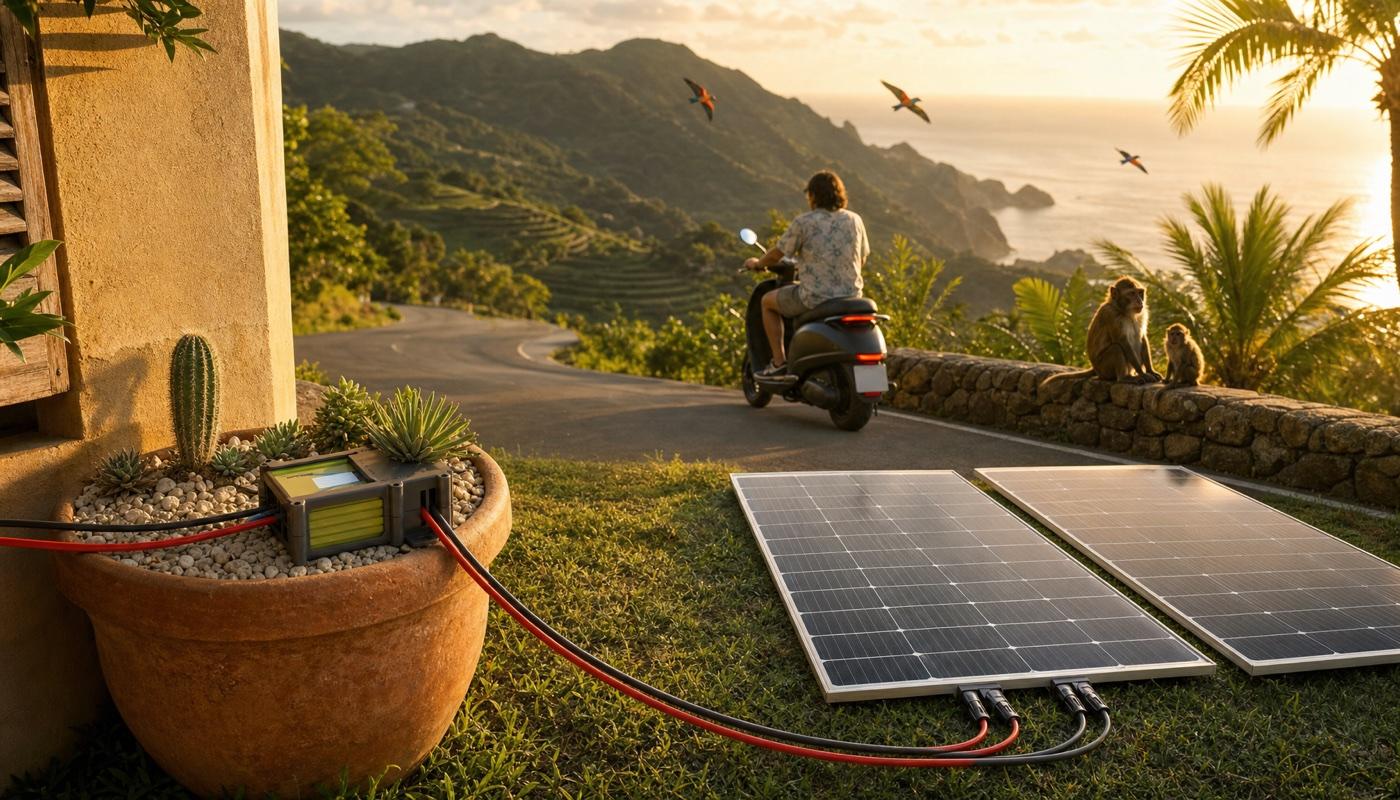
Unlike a home rooftop solar install or an AC portable power station, a direct e-bike solar kit has no inverter and no second battery. It connects four DC components in a single ~95%-efficient chain. Click any component below to inspect its role:

3. DC-DC Boost MPPT Converter (in Custom Strain-Relief Shell)

A DC-DC step-up converter that boosts 18–36 V panel power up to your battery pack's exact constant-voltage ceiling at ~95% efficiency — with no 120V AC inverter loss. Protected inside our custom 3D-printed strain-relief & button-guard enclosure.

Affiliate Disclosure (A1): Some outbound retailer links on our site are affiliate links, meaning we may earn a commission at no extra cost to you. Every component is selected strictly on electrical compatibility and safety, never commission. See our full affiliate disclosure.
Kit TierSolar ArrayDC-DC Boost ConverterCables, Fuse & PlugTypical Total
48V Commuter E-Bike Kit (51 km/day)1 × 100 W Monocrystalline Panel (~18 V Vmp)Boost MPPT DC-DC Converter (500 W PV, 13–60 V in) + 3D-Printed Strain-Relief Shell5 m 4 mm² MC4 lead + inline DC fuse + 2-wire plug~$380
60V E-Moto Kit (51 km/day)2 × 140 W Panels in Series (280 W, ~39 V Vmp)Boost MPPT DC-DC Converter (500 W PV, 13–60 V in)5 m 4 mm² MC4 lead + inline DC fuse + LP-20 / barrel pigtail~$651

Mandatory Safety Verification (A2/A3): Read Your OEM Charger Label & Meter Polarity First

Never copy a boost converter voltage setting from an online table or trust third-party wire colors. Before connecting any solar hardware: (1) Read the exact DC OUTPUT constant-voltage ceiling printed on your own OEM AC charger nameplate; (2) Plug your OEM charger into the wall and meter its isolated DC output plug with a digital multimeter to verify both the voltage ceiling and which contact is positive (+) and negative (−) — never probe an unshrouded battery socket blind; and (3) Fit an inline DC fuse on the battery-side positive lead and cover your solar panels while terminating connections at the bench.

5 · Deep-Dive Solar E-Bike & Scooter Guides

Explore our technical guides on wattage sizing, boost MPPT & safety

This hub covers US economics and model compatibility. Dive into our engineering guides for the step-by-step wattage math, boost vs buck MPPT topology, and multimeter verification:

Guide #7 · CostPublished

Solar E-Bike Kit Payback: 0.8 to 3.0 Years on US Fuel

Every payback figure here is the kit price divided by one year of petrol for the bike the vehicle replaces — a 50 cc moped at 1.71 L/100 km for the e-bikes, a 125 cc scooter at 2.1 for the Sur-Ron, a 300 cc maxi-scooter at 3.0 for the NIU — computed by the same planner our kit builder runs. Five US vehicles, four daily distances, 0.83–2.97 years, plus the cases where a kit never pays back.

6 · Frequently Asked Questions (FAQ)

Common questions about solar panels for electric bikes and scooters

Is a solar panel for an electric bike worth it in the US?

It depends on what you are comparing it against. If you store your e-bike in a shed, detached garage, carport, or van without an AC outlet, a ~$380–$651 direct DC solar kit beats a $1,500–$2,500 electrician trenching quote on day one. If you camp or ride off-grid (especially with a 60V Sur-Ron or fat-tire e-bike), it replaces $2.50–$3.90 of gas generator fuel per charge and pays back in under a year. Against a residential wall outlet alone, payback is 3.5–5.5 years in high-rate states like California (29.8¢–48.1¢/kWh) and 6–9 years at the 18.2¢/kWh US national average.

How many watts of solar do I need for a 48V e-bike vs a 60V electric dirt bike?

For a 31.7 mi/day (51 km/day) commute in 4.5 US peak sun hours, a 48V commuter e-bike (RadRunner 2, Lectric XP 3.0, Aventon Aventure 2) uses roughly 362 Wh/day and needs 140 W of panel (about 4 hours of sun). A 60V e-moto like the Sur-Ron Light Bee X (32 Wh/km, 1632 Wh/day for 51 km) needs 400 W — 4 × 100 W modules in series — because the array has to cover the whole day's energy and the modules are sold in fixed sizes.

Why do I need a boost MPPT DC-DC converter instead of a normal 12V/24V solar controller?

A standard 100 W portable or rigid solar panel operates around 18 V–20 V Vmp, whereas a 48 V e-bike battery requires 54.6 V DC (and a 60 V pack requires 67.2 V DC) to charge. Ordinary RV/marine solar controllers are buck (step-down) units that stay completely off when panel voltage is lower than battery voltage. A boost MPPT DC-DC converter steps the panel's 18 V–36 V output up to your pack's charging voltage at ~95% efficiency.

Can I charge a Bosch, Shimano STEPS, or Specialized e-bike with a direct DC solar kit?

No. Closed mid-drive systems like Bosch BES2/BES3 ('the smart system') use proprietary multi-pin connectors that require a 5V wake signal and a CAN-bus digital handshake between the OEM charger and the battery BMS before the charge fet will close. Our direct DC kits only support vehicles with a 2-wire DC charge port and no digital handshake — such as Rad Power, Lectric, Aventon, and the Sur-Ron Light Bee X (whose 3-pin LP-20 port leaves pin 3 unconnected).

How is a direct DC solar kit different from a Jackery or EcoFlow portable power station?

A portable power station forces your solar energy through three conversion stages: solar panel DC into the station's internal battery, DC-to-120V AC through its inverter, and 120V AC back to DC through your e-bike's black charger brick. That double conversion loses 25–28% of your solar watts and costs $350–$600+ for a second lithium battery you don't need. A direct DC boost converter sends solar power straight into your e-bike's own battery in a single ~95%-efficient step.

How do I verify my e-bike's charging voltage and plug polarity before connecting solar?

Never rely on a chart or internet forum for a voltage setpoint or wire color. Read the exact DC OUTPUT constant-voltage rating printed on your own OEM AC charger nameplate, then plug your OEM charger into the wall and probe its isolated output plug with a digital multimeter to confirm both the DC voltage ceiling and which pin/contact is positive (+) and negative (−). A fuse on the battery-side lead is defence in depth rather than a requirement — the vehicle has its own main fuse — but if you fit one, that is the side to put it on.

Ready to size a solar kit for your exact e-bike or scooter?

Pick your vehicle and daily commute in our free interactive builder to get a complete parts list, wire gauges, and step-by-step assembly instructions.

Size Your Solar Kit Free →