

QuietKat Apex XD
- Battery
- 48 V · 30 Ah1,440 Wh · unknown
- Motor
- 1,000 W
- Top speed
- 45 km/h
- Range
- 145 km
- Consumption
- 9.9 Wh/kmestimated
Can You Solar Charge a QuietKat Apex XD?
No AC inverter needed · No $500 power station · Plugs into the Julet 3-pin port
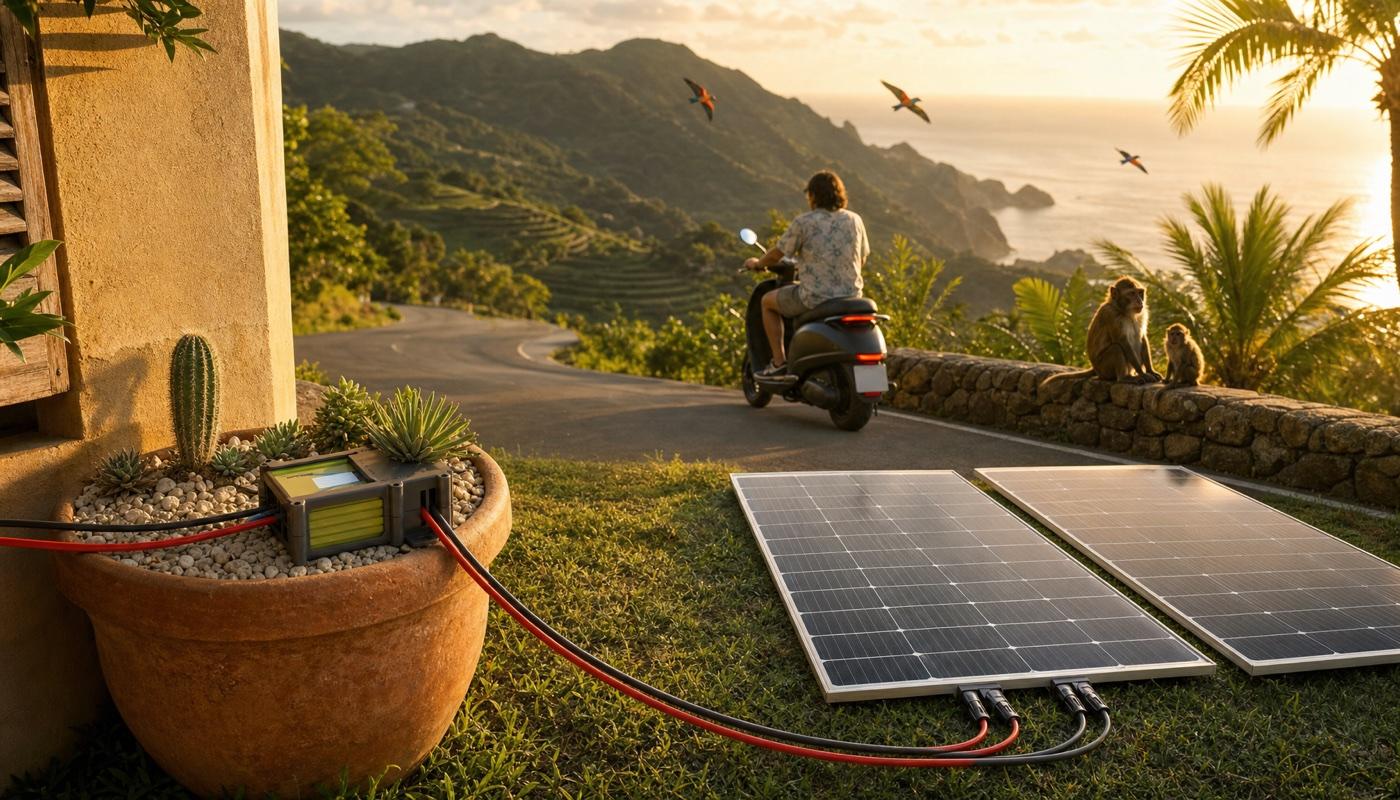
A 200 W solar array (2 × 100 W in series) feeding a DC boost MPPT controller recovers a 51 km/day commute on the QuietKat Apex XD in about 3.7 peak sun hours (4.5 sun hours/day market average). The Apex XD uses a 48 V 1,440 Wh unknown pack (recorded OEM charger ceiling: 54.6 V DC, confidence: Medium, source — always read your own charger nameplate & verify with a multimeter) and charges through its Julet 3-pin port.

200 W Solar Array
2 × 100 W (2S)
~3.7 hrs sun for 51 km
Daily 51 km commute recovery
~1.2 yr payoff vs. gas
Saves ~$359/yr
Similar vehicles & kit parts
Riders also viewed
- Aventura-X EV3072 V · 2.9 kWh200 W kit · GX16 aviation plug
 EV
- EMOVE RoadRunner V348 V · 1.1 kWh100 W kit · XLR 3-pin
 EV
- Heybike Mars 3.048 V · 0.6 kWh50 W kit · DC 5.5 x 2.5 mm barrel (DC5525)
 EV
- Heybike Titan48 V · 0.7 kWh100 W kit · DC 5.5 x 2.1 mm barrel (DC5521)
 EV
- 200W solar array — 2 × 100WKit part
 Part
- DC cable, panel to controller — 4mm² min · 5.26mm² suppliedKit part
 Part
- MPPT charge controllerKit part
 Part
2 · Kit Cost, Payoff Period & Direct DC Efficiency
Should You Solar Charge Your QuietKat Apex XD?
Let's consider the important factors — upfront kit cost, payback against buying gas and wall electricity, total cost of ownership versus a new gas scooter, air and noise pollution, and local legal rules in United States — so you can decide for yourself.
How much does a solar kit for a QuietKat Apex XD cost?
A complete direct-DC solar charging kit for the QuietKat Apex XD costs $431 (including 2 × 100 W monocrystalline panels, a DC boost MPPT controller, sized solar cables, and the matched Julet 3-pin plug) — roughly one-third the cost of a portable power station setup.
Will You Save Money over Gas?
10-Year Cumulative Fuel Savings — QuietKat Apex XD
~1.2 yrs
Payoff breakeven vs. buying gas (~$359/yr)
~9.3 yrs
Payoff breakeven vs. wall outlet (~$39/yr)
+$3,879
Net profit vs. gas by Year 10 ($469 in grid kWh avoided)
Is a solar-charged QuietKat Apex XD really cheaper than petrol?

QuietKat Apex XD + Solar
1 kW · 1.44 kWh unknown · 45 km/h · 145 km range
$4,830/5 yrs

Honda Ruckus 49cc (Gas)
49cc · 47.6 km/L · 64 km/h
$2,527/5 yrs
Why direct DC boost beats a portable power station
Solar Efficiency
Share of panel wattage that reaches the battery
Charges the QuietKat Apex XD's own 1,440 Wh pack directly without wasting 25–28% of your solar wattage in a DC→AC→DC inverter loop.
Zero home breaker stress (off-grid ready)
Draws 0 W from your home breaker vs. 450 W from the factory AC brick — preventing breaker trips and charging in unpowered sheds or carports.
Will Solar-Charging a QuietKat Apex XD Reduce Air Pollution (CO₂ & PM2.5)?
In United States, the utility power grid averages 380 g CO₂/kWh (16% coal/fossil share). Charging your QuietKat Apex XD directly from solar eliminates both tailpipe exhaust and power-plant smokestack emissions:
Carbon Emissions per Kilometer (g CO₂/km)
Breathable PM2.5 Air Particles (mg PM2.5/km)
Sources: US EPA eGRID National Average (~380 gCO2/kWh); EMEP/EEA Two-Wheeler Emission Inventory & IPCC AR6.
Will Driving a Solar-Charged QuietKat Apex XD Reduce Noise Pollution?
Decibels (dBA) are logarithmic: every +10 dB sounds twice as loud to the human ear. The QuietKat Apex XD's brushless electric motor cuts city pass-by noise by 23 dBA (~80% quieter) compared to a 125cc gas scooter, and solar-charges at 0 dBA:
Is It Legal to Solar-Charge a QuietKat Apex XD in United States?
Relevant authority: Local AHJ / Utility Interconnection & NEC Article 690
Utility interconnection agreements and municipal roof-solar permits apply to grid-interactive AC photovoltaic systems wired into a home's breaker panel. A portable or ground/shed-placed low-voltage DC solar charger (< 60 V DC, 100-400 W) that plugs straight into an e-bike or scooter battery is a standalone DC appliance and requires no utility approval.
- Zero Utility Interconnection: Never touches 120V/240V household AC wiring.
- Low-Voltage DC (< 60 V): Below NEC high-voltage thresholds with no AC inverter.
- HOA & Renter Friendly: Ground, balcony, or shed placement requires no roof penetration.
Ride more or less than 51 km/day? Adjust your daily distance, panel mounting, and cable runs for the QuietKat Apex XD:
Size Your Apex XD Kit →2a · Head-to-head
How does it compare to popular EVs?
Bars are scaled to the highest value in this group. Cost per km = vehicle price + its solar kit + upkeep, over the same distance for every row (51 km/day for 5 or 10 years); a model with no solar kit pays for grid energy instead. Prices are this market's own figures, shown in your display currency.
Price
new vehicle price- QuietKat Apex XDThis model
- $4,249
- QuietKat Apex HD
- $3,249
- QuietKat Ibex
- $3,499
- Heybike Titan Dual Battery
- $1,699
- Yamaha Wabash RT
- $4,199
Top Speed
- QuietKat Apex XDThis model
- 45 km/h
- QuietKat Apex HD
- 45 km/h
- QuietKat Ibex
- 45 km/h
- Heybike Titan Dual Battery
- 32 km/h
- Yamaha Wabash RT
- 45 km/h
Range
- QuietKat Apex XDThis model
- 145 km
- QuietKat Apex HD
- 145 km
- QuietKat Ibex
- 101 km
- Heybike Titan Dual Battery
- 129 km
- Yamaha Wabash RT
- —
Battery Size
- QuietKat Apex XDThis model
- 1.4 kWh
- QuietKat Apex HD
- 1.4 kWh
- QuietKat Ibex
- 1.0 kWh
- Heybike Titan Dual Battery
- 1.4 kWh
- Yamaha Wabash RT
- 0.5 kWh
Motor Wattage
- QuietKat Apex XDThis model
- 1 kW
- QuietKat Apex HD
- 1 kW
- QuietKat Ibex
- 1 kW
- Heybike Titan Dual Battery
- 750 W
- Yamaha Wabash RT
- 250 W
Solar Chargeable
— = no plug on record yet- DC charging
- AC charging
- QuietKat Apex XDThis model
- DC charging: not recorded
- AC charging: Yes
- QuietKat Apex HD
- DC charging: not recorded
- AC charging: Yes
- QuietKat Ibex
- DC charging: not recorded
- AC charging: Yes
- Heybike Titan Dual Battery
- DC charging: Yes
- AC charging: Yes
- Yamaha Wabash RT
- DC charging: No
- AC charging: Yes
Cost per km (5 years)
incl. vehicle + kit + upkeep- QuietKat Apex XDThis model
- $0.05/km
- QuietKat Apex HD
- $0.04/km
- QuietKat Ibex
- $0.04/km
- Heybike Titan Dual Battery
- $0.02/km
- Yamaha Wabash RT
- $0.05/km
Cost per km (10 years)
incl. vehicle + kit + upkeep- QuietKat Apex XDThis model
- $0.03/km
- QuietKat Apex HD
- $0.02/km
- QuietKat Ibex
- $0.02/km
- Heybike Titan Dual Battery
- $0.01/km
- Yamaha Wabash RT
- $0.03/km
Compare them side by side, attribute by attribute →
3 · Solar Kit Parts for QuietKat Apex XD
What do you need to solar charge a QuietKat Apex XD?
Click any part below to open the full parts list with safety disclaimers & live retailer links, or customize your daily distance and cable lengths in the free kit configurator:
2×1 m1×1 m 1×
 1×
 1×
 1×
 Optional
 Optional
 Optional
Estimated core kit total: $431
See per-item pricing, electrical safety disclaimers, and direct local retailer links on the full parts list page.
Watch: 3D Solar Kit Assembly & Safe Wiring Sequence in Action
Placing the panel in full sun, landing PV and battery leads into the dead MPPT terminals first, verifying CV target voltage on the lit LCD, and closing the strain-relief armor.
4 · Complete BOM, 15-Step Assembly Guide & Safe Verification
How to Charge a QuietKat Apex XD With Free Solar Power
To charge a QuietKat Apex XD directly from sunlight without an AC inverter or portable power station, a 200 W solar array (2 × 100 W wired in 2S series) feeds a DC-DC boost MPPT controller that steps the array's 36 V Vmp up to your 48 V pack through its Julet 3-pin port. We built two products specifically for the QuietKat Apex XD so you never have to guess a part, wire gauge, or assembly step:
Your QuietKat Apex XD Parts List (BOM)
Itemizes every required component and safety tool for your Apex XD kit (estimated core total $431) with direct retailer links — cleanly separated from optional extras so you never overbuy:
- Required Core Hardware (5 items): 2 × 100 W solar panels, DC boost MPPT controller, 5.26 mm² panel cable (5 m run), 5.26 mm² vehicle cable (3 m run), matched Julet 3-pin plug.
- Required Build & Safety Tools (4 items): Digital multimeter (to test panel Voc & meter your OEM charger), wire cutters/strippers, insulated gloves, and clear safety glasses.
- Optional Extras (Never Required — unticked by default): 3D-printable MPPT strain-relief & button-locking shell, 45° PV cable bend guides, and an optional inline DC fuse (belt-and-braces protection for long runs — not required because the MPPT controller already limits its own output current and the scooter has a main battery fuse).
Solar Kit Assembly Instructions + AI Build Assistant
Our interactive step-by-step build guide generated specifically for your QuietKat Apex XD configuration — taking you from unpacking boxes to a verified solar charge in strict dead-wires-first order:
- Tailored to your exact kit parts: Custom schematic diagrams and exact strip/cut lengths for your 5.26 mm² (5 m) panel run, 5.26 mm² (3 m) vehicle run, and Julet 3-pin connector.
- Strict dead-wires-first electrical order: Every screw terminal and wire splice is completed while panels are covered/unplugged and the scooter is disconnected — you never handle a live conductor.
- Includes US$5 of AI Build Assistant credit: Snap a photo of your multimeter reading, MPPT terminal wiring, or solder-seal splice at any step for instant verification before plugging in (plus read-aloud audio on every step).
The 4 Build Phases: How Your QuietKat Apex XD Solar Kit Goes Together
Because the charge socket on your QuietKat Apex XD is a live battery terminal, our 15-step assembly guide sequences the build into four distinct phases so you never guess polarity or work on live wires:
Check your BOM, test panel Voc (~22.4 V) in sun & dry-fit the layout
Verify all required parts and safety tools against your Bill of Materials (BOM). Before mounting anything (while still inside the seller's return window), place each panel in full sun and measure open-circuit voltage (~22.4 V DC per panel) with your multimeter. Position the panels in unshaded sun and the boost MPPT in dry ventilated shade, then dry-fit both cable runs before cutting wire.
Wire the array & land both MPPT terminal blocks while completely dead
Join the 2 panels (2S) and check ~44.8 V string Voc with your meter, then leave the panel MC4 leads unclipped (or keep panels covered). Route the 5.26 mm² panel cable and 5.26 mm² vehicle cable, and screw both into the MPPT's PV+/PV− and BAT+/BAT− terminals in one sitting while zero voltage is present.
Meter your isolated OEM charger plug & bench-splice the Julet 3-pin lead
Never plug bare pigtail wires into the scooter or probe the live vehicle socket blind. Plug your factory AC wall charger into the wall and probe its isolated DC output plug with your multimeter to identify positive (+) and negative (−). At the bench with everything disconnected, slide on the yellow 4.0–6.0 mm² solder-seal tube first, heat-splice the two power conductors, tug-test, insulate unused signal pins separately, and meter for zero continuity between + and −. (An inline DC fuse is optional belt-and-braces protection for long runs, not a requirement, since the MPPT limits its own output and the scooter has a main fuse.)
Boot the MPPT on solar, set your verified CV & current limits, plug in & verify on the dash
Clip the solar array MC4 connectors together first (with the scooter still unplugged) so the MPPT display boots on solar power. Read the DC OUTPUT rating on your own OEM charger nameplate (confirmed by your multimeter) and set the MPPT's constant-voltage (CV) ceiling at or slightly below that figure — never above — along with the current limit. Plug into the QuietKat Apex XD, watch watts climb on the controller, and verify after 10 minutes that your scooter's dashboard battery % has risen.
All 15 Steps Generated for Your QuietKat Apex XD Kit
- 1Gather required parts & tools against your Bill of Materials (BOM)Free Sample
- 2Test each panel's open-circuit voltage (~22.4 V Voc) in full sun before mounting
- 3Plan the layout (panels in full sun, boost MPPT in dry shade, dry-fit cable runs)
- 4Mount or place the 2 panels with a 0.5 m seasonal service loop
- 5Wire the 2 panels in 2S & verify ~44.8 V string Voc with your multimeter
- 6Run the 5 m (5.26 mm²) panel cable to the controller (leave array unplugged)
- 7Wire the panel cable into the MPPT PV+ and PV− screw terminals while dead
- 8Run the 3 m (5.26 mm²) vehicle DC cable from the MPPT to your parking spot
- 9Wire the vehicle cable into the MPPT BAT+ and BAT− terminals in the same dead sitting
- 10Meter polarity on your isolated OEM charger plug & assemble the Julet 3-pin adapter at the bench
- 11Clip the solar array MC4 leads together to wake the MPPT display (~44.8 V PV in, scooter still unplugged)
- 12Read DC OUTPUT on your OEM charger nameplate, verify with your meter & set the MPPT CV ceiling
- 13Set the MPPT charge current limit at or below your OEM rating (this array supplies ~3.7 A)
- 14Plug the verified Julet 3-pin connector into the QuietKat Apex XD & watch the MPPT settle into charging
- 15Confirm climbing watts on the MPPT & verify the scooter's dashboard battery % rises after 10 minutes
Recorded QuietKat Apex XD Charger Specs & Connector Family
The table below lists the battery architecture, recorded OEM wall charger specifications with their confidence level and source, and our connector verification status. We never recommend an MPPT voltage setpoint: always read the DC OUTPUT rating on your own OEM charger nameplate and verify it with a multimeter.
| Nominal Voltage | 48 V DC |
|---|---|
| Pack Capacity | 1,440 Wh (30 Ah) |
| Battery Chemistry | unknown (Removable pack) |
| Recorded OEM Charger Rating | 54.6 V DC max · 2 A (109 W) Medium |
| Connector Family | Julet 3-pin Medium |
| Pin Count & Gender on Vehicle | 3-pin · unknown (on vehicle) |
| Adapter Verification Status | Identified · Family confirmed |
Recorded Data Sources
- QuietKat Apex XD, read 2026-11-20: mid-drive 1000 W VPO 2.0, 5-speed internally geared, 30Ah/48V 1440Wh, up to 90 miles, 325 lb payload; variants 15 Ah $3,999 / 30 Ah $4,249.
- Apex XD specification block: 'Battery: 30Ah/48V | 1440Wh', 'Range: Up to 90 Miles', 5-speed automatic drivetrain, 1500 W climb mode.
Solar Kit Assembly Instructions + AI Build Assistant
Follow interactive wiring diagrams for your exact cable gauge and connector family, with an AI build assistant ready to verify photos at every step.
5 · QuietKat Apex XD Solar Charging FAQ & Distance Sizing
QuietKat Apex XD Solar Charging FAQ
How many watts of solar do I need to charge a QuietKat Apex XD?
For a 51 km/day (31.7 mi/day) commute (~505 Wh/day), the QuietKat Apex XD needs a 200 W solar array (2 × 100 W wired in series) feeding a DC boost MPPT controller. At 4.5 peak sun hours/day, 200 W recovers a 51 km ride in about 3.7 sun hours.
How do I verify the OEM charger voltage and pin polarity on the QuietKat Apex XD?
Our dataset records the QuietKat Apex XD OEM charger ceiling at 54.6 V DC (confidence: medium), but you should never copy a voltage figure blindly from the web. Read the "DC OUTPUT" rating printed on your own original OEM AC wall charger nameplate, then plug the OEM brick in and probe its isolated DC output plug with a digital multimeter to verify both the constant-voltage ceiling and which pin is positive (+) and negative (−) before wiring your Julet 3-pin lead (port status: identified).
Can I charge the QuietKat Apex XD from solar while riding?
No. Direct DC solar kits are designed for stationary daytime charging while parked at home or work, with the panels in full sun and the boost MPPT resting in ventilated shade. Many vehicle BMS units also inhibit throttle output while the charge port is active.
Sunshine Hours & Array Sizing by Daily Distance (10–40 km/day)
Computed from a consumption rate of 9.9 Wh/km, a 1,440 Wh pack, 4.5 peak sun hours/day in United States, a 0.70 real-world panel derating factor, and boost MPPT + DC cable efficiency.
| Daily Distance | Daily Wh | Recommended Array | Wiring & Vmp | Sun Hrs to Recover | 0–100% Full Pack |
|---|---|---|---|---|---|
| 10 km/day | 99 Wh | 100 W (1 panel) | 1S · 18 V Vmp | 1.5 hrs | 12.1 sunny days |
| 20 km/day | 198 Wh | 100 W (1 panel) | 1S · 18 V Vmp | 3 hrs | 6.9 sunny days |
| 30 km/day | 297 Wh | 140 W (1 panel) | 1S · 19.5 V Vmp | 3.2 hrs | 4.4 sunny days |
| 40 km/day | 396 Wh | 140 W (1 panel) | 1S · 19.5 V Vmp | 4.3 hrs | 3.5 sunny days |
| 51 km/day | 505 Wh | 200 W (2 panels) | 2S · 36 V Vmp | 3.7 hrs | 2.8 sunny days |