
Why Solar Cars Failed for 70 Years — and Why a Solar E-Bike Works
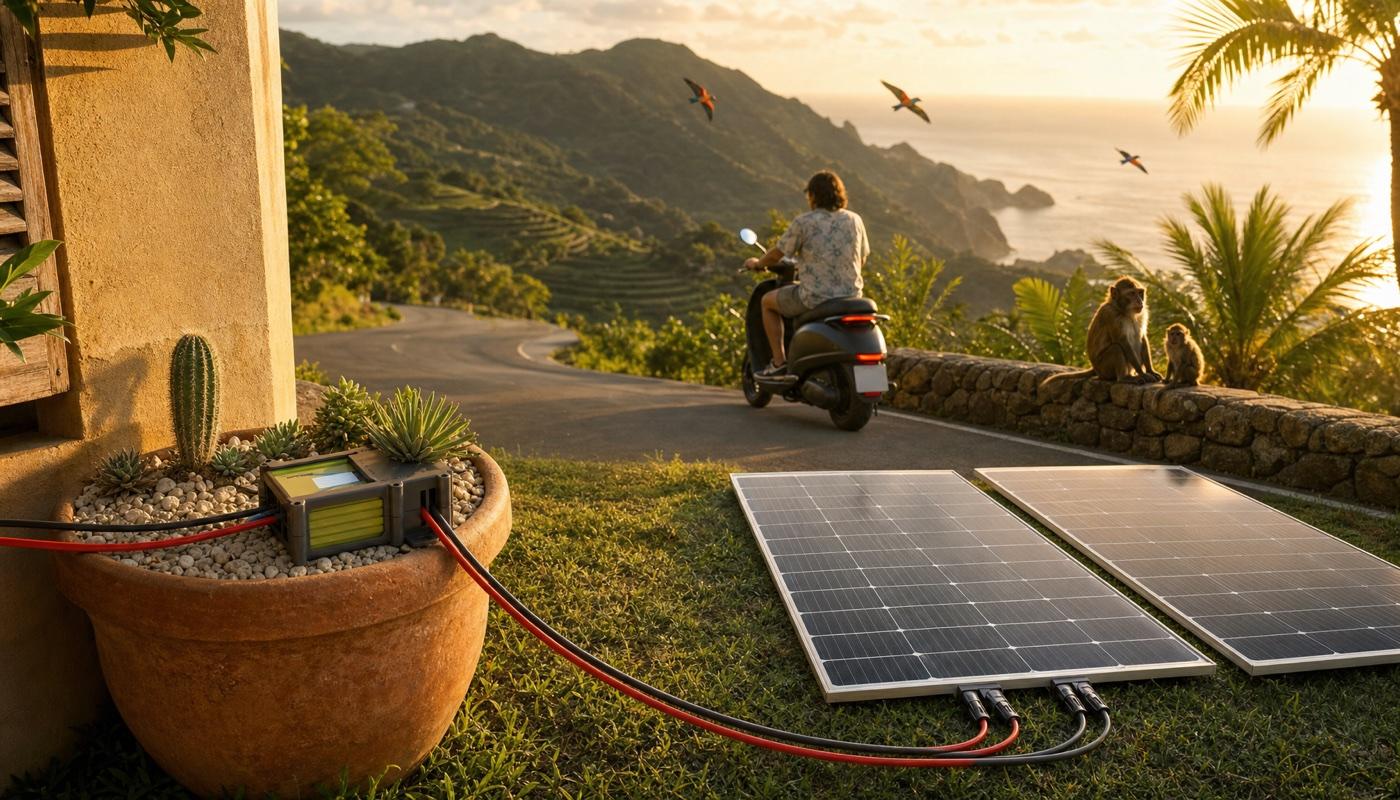
Every few years a solar car is announced, and every few years it fails. The usual explanation is that the panels are not good enough. The panels are extraordinary: a module fell from $99.60 a watt to $0.12 in 49 years. The problem was never the cell. It was the roof.
Summary
A car's roof is 1.7–2.5 m² of panel; cover the whole bonnet, roof and boot like the Lightyear 0 and it is 5 m². At 1,000 W/m² and 22.7% module efficiency that is about 1,135 W, which moves a 96 Wh/km car 11.8 km per peak sun hour — and a roof-only 2.5 m² gives 568 W and 5.9 km. A light EV uses 5.2–30.7 Wh/km — 4.9–80 times less — so the same panel that is a rounding error on a car is a day's fuel on an e-bike.
Four inventions turned that physics into a product you can buy for $799 plus a $354 kit: the silicon cell, the MPPT and boost converter, lithium/LFP, and the neodymium brushless hub motor. Every date and price below carries its source.
1 · The Paradox
A Car Roof Is 1.7–2.5 m². A Car Uses 149–417 Wh/km. That Is the Whole Story.
The standard terrestrial sunlight figure is 1,000 W/m². A car's roof gives 1.7–2.5 m² of panel — a Leaf 1.8 m², a Model S 2.5 m². Cover the bonnet, roof and boot as the Lightyear 0 did and you get 5 m², which at 22.7% module efficiency is 1,135 W. Its own WLTP consumption was 96 Wh/km, so at rated output that array makes 11.8 km of range per peak sun hour; a roof-only 2.5 m² makes 5.9 km.
Put that on a good day and it reads like a product: 47 km from four sun hours, and about 70 km from six — which is exactly what Lightyear claimed for southern Spain. Nothing about it is impossible. It is simply the best a car-shaped object can do, and it cost €250,000.
| One vehicle, one sunny day | Solar car (Lightyear 0) | Light e-bike (Lectric XP Lite 3) |
|---|---|---|
| Panel on the vehicle | 5 m² of bodywork | 100 W panel laid beside it |
| Peak array power | ~1,135 W at 1,000 W/m² | 100 W at 1,000 W/m² |
| Energy per km | 96 Wh/km (WLTP) | 5.2 Wh/km |
| Range added per peak sun hour (rated array) | 11.8 km | about 19.2 km |
| What it cost | €250,000 | $799 + $354 kit |
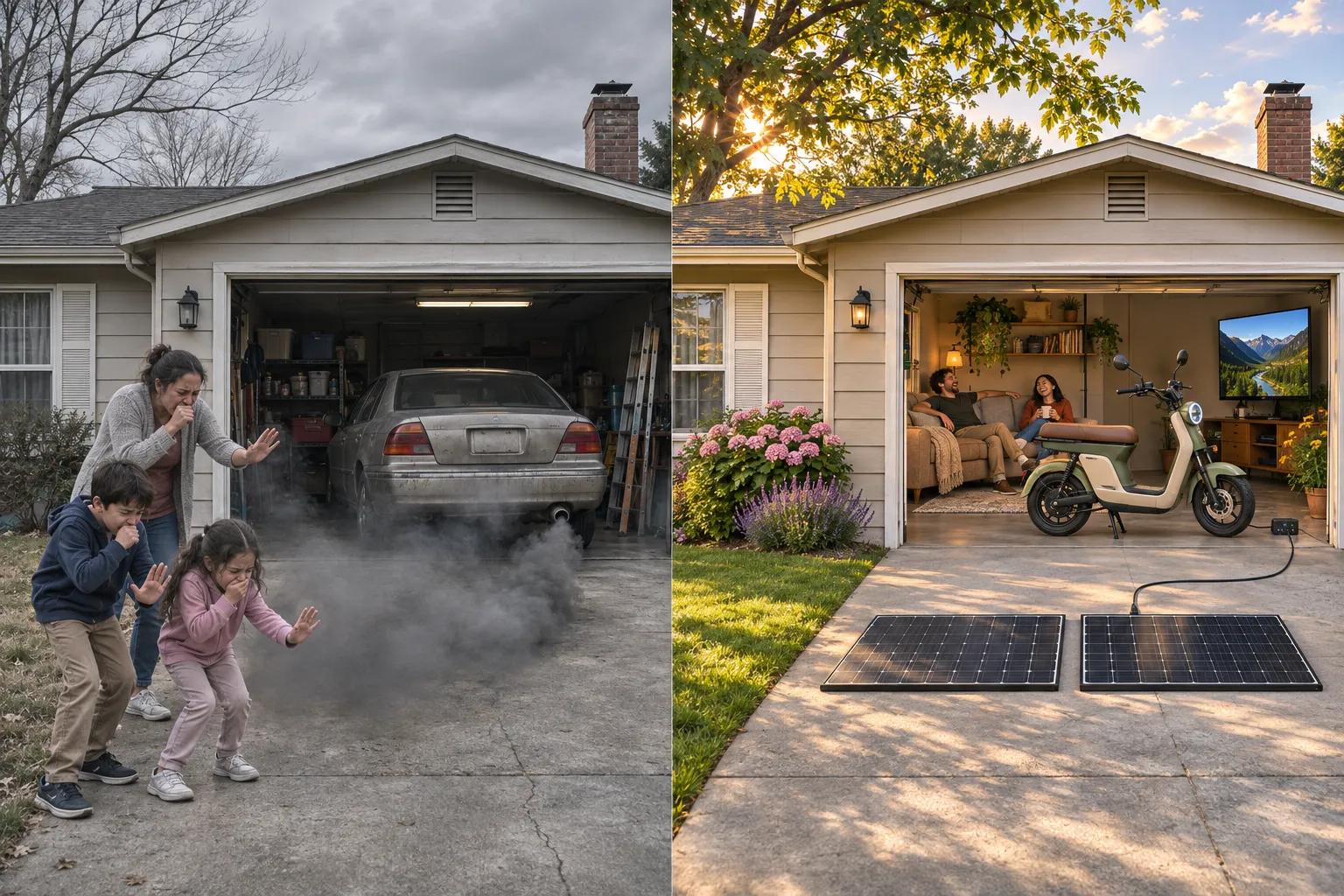
The e-bike's panel is smaller and its range per sun hour is larger, because the vehicle is a fraction of the car's mass and travels at a fraction of its speed. That is the entire argument: solar charging is a question of how much energy a kilometre costs, and a light EV is where that number is small enough for a roof-sized array to matter.
The EPA's model-year 2024 ratings put US electric cars between 149 and 417 Wh/km on the combined cycle. The three light EVs this site publishes — the Lectric XP Lite 3, the Segway Ninebot Max G2 and the NIU FX Pro — use 5.2, 12.2 and 30.7 Wh/km. Divide one by the other and a car costs 4.9 to 80 times more energy per kilometre.
Energy per kilometre: cars against the light EVs this site sells kits for
The kit that makes the small number work — panels, a boost controller, cable and the adapter for your own port — is priced for your vehicle and your daily distance in the solar kit builder.
2 · Seven Decades
1955–2023: Every Solar Car Almost Worked
The history is not a story of bad engineering. It is a story of good engineering pointed at a vehicle whose roof could never be big enough. Each of these cars proved the thing it set out to prove, and each one ran into the same wall.
| Year | Car | What it proved | What stopped it |
|---|---|---|---|
| 1955 | GM Sunmobile (William G. Cobb) | 12 selenium cells can turn sunlight into motion — the first model solar car, 15 inches long | It was a 15-inch demonstration, not a vehicle |
| 1958–60 | International Rectifier 'Solar King' (Dr Charles Escoffery) | 10,640 silicon cells on a 1912 Baker Electric, a 2.34 m² tilting roof, a 72 V pack | Published output is 100–200 W; a promotional conversion, not a product |
| 1982 | The Quiet Achiever (Hans Tholstrup & Larry Perkins) | 4,084 km across Australia on a 1,000 W array, averaging 30 km/h | A single-seater at bicycle speeds |
| 1987 | GM Sunraycer | Won the first World Solar Challenge: 3,005 km in 44.9 running hours, 66.9 km/h average | A purpose-built racer with no cargo, no passenger and no weather |
| 2023 | Lightyear 0 | A road-legal five-seater with 5 m² of cells, a 60 kWh pack and 625 km WLTP | €250,000, a handful of cars built, and the factory bankrupt within months |
| 2023 | Sono Motors Sion | A solar-assisted hatch with cells integrated into the bodywork | Programme terminated before production, after more than a decade |
Every row is sourced in `solar-ekit/data/guides/why-solar-cars-failed-70-years/history-facts.json`. The Sunraycer's 66.9 km/h is its running average; the 44.9 in most retellings is its running TIME in hours.
Two details are worth keeping, because they are the ones the retellings get wrong. The 1960 Solar King is usually described with a single panel wattage, but the sources disagree by a factor of two — one history of solar cars derives about 100 W from the panel area and cell count, IAA Mobility states 200 W — so this page prints the range rather than picking the better story. And the Sunraycer's famous '44.9' is hours, not miles per hour: 3,005 km in 44.9 hours is 66.9 km/h, which was still fast enough to beat every other car in 1987 by two and a half days.
What the timeline does not show is the cost curve underneath it. The Sunmobile's selenium cells and the Solar King's silicon cells were laboratory objects; the Sunraycer's gallium-arsenide array was space hardware. A car needs hundreds of watts of panel, and at the 1976 price a hundred watts of it was $9,960 — which is why every array in the table above was a laboratory or a sponsor's gift. That is the subject of the next four sections.
3 · Breakthrough 1
From a 1% Selenium Slab to a 24.8% Module
The photovoltaic effect was found in 1839 by a 19-year-old, turned into a 1% selenium cell in 1883, explained by Einstein in 1905, and made practical at Bell Labs in 1954 — a silicon p-n junction at about 6%. Everything since has been manufacturing.
The chain from quartz to a module is the part most histories skip, and it is where the cost came out. Quartz is reduced to metallurgical-grade silicon at about 99% purity; the Siemens or fluidised-bed process distils trichlorosilane and deposits 9N polysilicon (99.9999999%); a Czochralski ingot is pulled from that melt — the method Jan Czochralski published in 1916 — and diamond-wire sawing cuts it into wafers about 150 µm thick. A commercial crystalline-silicon module averaged 22.7% in Q4 2024, with the best at 24.8%.
Quartz to module: the seven steps that took the price out
Quartz (SiO₂) to metallurgical silicon
the feedstock every crystalline module starts from
Ingot to module
$0.12 a watt, from $99.60 in 1976
| Year | Module price (constant 2025 US$/W) | What changed |
|---|---|---|
| 1956 | ≈$300 (cell, not module) | Bell Labs' first silicon cells; satellites were the only customer |
| 1976 | 99.60 | Terrestrial modules exist; a watt still costs a day's wage |
| 1990 | 12.09 | Manufacturing scale, thinner wafers, larger ingots |
| 2000 | 6.50 | Grid-connected demand begins |
| 2010 | 2.51 | Chinese polysilicon capacity and module scale |
| 2020 | 0.32 | Diamond-wire sawing, PERC, 9N feedstock at scale |
| 2025 | 0.12 | n-type TOPCon/HJT at 22.7% average module efficiency |
1976–2025 is Our World in Data's IRENA/Nemet series, restated in constant 2025 dollars. The 1956 point is IEEE Spectrum's mid-1950s cell price and is a cell rather than a module, so it is marked medium confidence in the fact-sheet.
The first customer was not a car. Vanguard 1, launched in 1958, carried 6 silicon cells making about 1 W, and its battery-powered transmitter died within months while the solar one kept broadcasting until 1964. That is the whole commercial argument for photovoltaics in one satellite: the panel outlived the battery, and nobody had to swap it.
4 · Breakthrough 2
The Controller That Refuses to Let the Panel Off Its Peak
A solar panel is not a fixed voltage source. Its maximum power point moves with light and temperature, and a controller that tracks it — an MPPT — was built for spacecraft in the 1960s. The terrestrial version arrived in the 1980s, and the boost variant is what makes a 48–72 V scooter pack chargeable from an 18–36 V panel.
RCA's 1968 Space Congress paper describes high-speed maximum power trackers already flying on spacecraft arrays. AERL, founded in 1985 by the Australian engineer Stuart Watkinson, built high-efficiency trackers for solar racing vehicles — a company history, so the page records the date and the application without repeating its superlatives.
| The controller's job | Without it | Why a light EV needs it |
|---|---|---|
| Hold the panel at its maximum power point | The panel sits at whatever voltage the battery drags it to, giving up 10–30% of its watts | A 100 W panel has no watts to spare on a 20 km commute |
| Convert panel voltage to pack voltage | A PWM controller ties the panel straight to the pack and loses the difference as heat | An 18 V panel cannot charge a 76.8 V pack without stepping up |
| Block reverse current at night | The pack discharges back through the panel after sunset | The controller is the only thing between the pack and a dark panel |
| Stop at full | Overcharge protection becomes the pack's job, not the controller's | LFP is tolerant, not indestructible |
A boost MPPT is a switch-mode DC-DC converter: a MOSFET chops the panel's DC, an inductor stores the energy and a second switch delivers it at a higher voltage. Synchronous rectification is what makes the modern ones efficient.
There is a catch that decides which controller you buy. Most MPPT controllers only step voltage DOWN — a buck converter. A 48 V or 72 V pack needs the panel's voltage stepped UP, which is a boost converter, and it is a different product. That is why the kit for a 76.8 V NIU FX Pro is a boost MPPT and the kit for a 48 V e-bike can use either.
For the full explanation of MPPT against PWM, buck against boost, and what the controller does inside, read What is an MPPT charge controller?.
One rule this page will not break: it does not tell you what voltage to set. The controller's output has to match the DC voltage printed on the nameplate of the charger that came with your vehicle, verified by measuring that charger's plug with a multimeter. The right number belongs to your vehicle, not to a webpage.
5 · Breakthrough 3
What 2.5 kWh of Lead-Acid Would Have Weighed: 61–82 kg
Gaston Planté's lead-acid cell of 1859 stores 30–40 Wh/kg. The 2,457.6 Wh pack in a NIU FX Pro would weigh 61.4–81.9 kg in lead-acid — a mass no 76.8 V commuter of that class carries. As LFP it is the 24S pack the scooter actually ships.
The chemistry took a century to arrive. Whittingham demonstrated a rechargeable lithium cell with a titanium-disulfide cathode at Exxon in 1976; Goodenough's group replaced the sulfide with lithium cobalt oxide in 1980, taking the cell to about 4 V; Yoshino paired that cathode with a petroleum-coke anode in 1985, removing the reactive lithium metal; and Sony sold the first commercial lithium-ion cell in 1991. The three shared the 2019 Nobel Prize in Chemistry.
The variant that matters for a scooter is LFP. Padhi, Nanjundaswamy and Goodenough reported the olivine LiFePO₄ cathode in 1997: 3.5 V against lithium, 100–110 mAh/g, made from iron and phosphate rather than cobalt, and structurally stable enough to survive thousands of cycles. It is the reason a 76.8 V pack can sit in a vehicle that is charged every day and left in the sun.
Lithium-ion pack price, 2010–2024
That curve is the other half of the LFP story. A pack at $1,436 per kWh in 2010 was a car component; at $115 in 2024 — a fall of 92.0% — it is a scooter component. The cell chemistry made the pack safe and the price curve made it ordinary.
6 · Breakthrough 4
A Motor With No Brushes, No Chain and No Gearbox
Faraday produced continuous electromagnetic rotation in 1821 and induction in 1831. A brushed DC motor still needed a commutator to switch its coils — a wearing, sparking mechanical contact. The 1982 neodymium magnet and a three-phase inverter removed it.
Nd₂Fe₁₄B was developed independently and almost simultaneously in 1982 by Masato Sagawa at Sumitomo Special Metals (sintered) and John Croat at General Motors Research (melt-spun). It is still the strongest permanent magnet commercialised, and it is what lets a motor make useful torque in a package small enough to fit inside a wheel.
| Part | What it replaced | What it buys |
|---|---|---|
| 1982 Nd₂Fe₁₄B rotor magnets | Ferrite or samarium-cobalt magnets | More torque per kilogram, so the motor fits in the hub |
| Hall sensors + three-phase MOSFET inverter | The brushed commutator | No wearing contact, no sparking, electronic timing |
| Sealed outer-rotor hub | Chain, sprockets and gearbox | No drivetrain loss and no maintenance item |
| 85–91% peak efficiency | ≈75–80% for a brushed motor | More of the pack's watt-hours reach the road |
The efficiency band is a manufacturer's peak figure (QS Motor's 10-inch hub motor), not an independent cycle-average measurement; the fact-sheet marks it medium for that reason.
This is the breakthrough that is easiest to miss, because it does not look like a solar technology. But a kit is only as good as the chain it feeds: panels, controller, pack and motor. A brushed motor that wastes a fifth of the pack as heat would undo the panel's work, and a chain would add a maintenance item to a vehicle that is supposed to need none.
7 · Convergence
What the Four Inventions Add Up To in 2026
A $799 Lectric XP Lite 3 uses 5.2 Wh/km; a single 100 W panel and the rest of the kit come to $354, and five years of a 20 km day — the vehicle plus the kit, charged from the sun — works out at 5.1 cents a mile. A €250,000 solar car uses 96 Wh/km.
| Five years, 20 km a day | Lectric XP Lite 3 (US) | NIU FX Pro (TH) | Lightyear 0 |
|---|---|---|---|
| Vehicle price | $799 | ฿59,000 | €250,000 |
| Energy per km | 5.2 Wh/km | 30.7 Wh/km | 96 Wh/km |
| Solar array | 1 × 100 W | 2 × 200 W | 5 m² of bodywork |
| Kit price | $354 | ฿11,669 (≈$324) | included in the car |
| Five-year total | $1,153 | ฿70,669 | €250,000 plus charging |
| Per mile / per km | 5.1¢/mile | ฿1.94/km | — |
Every light-EV figure is `computeKitPlan` + `pricedKitTotal` + `fiveYearCostOfOwnership` on the dataset records, at 20 km/day for five years (36,500 km). The car column is its list price; its energy cost is not comparable because it is not sold with a kit. A dash is a figure this page cannot derive, not a zero.
Two numbers in that table are worth separating. The kit alone — panels, controller, cable and the adapter for the port — is 1.6 cents a mile over the same five years. The 5.1 cents a mile is the kit PLUS the bike, because a cost per mile that leaves out the vehicle is not a cost of owning one. Both are printed so a reader can see which claim is which.
That is what 70 years of solar-car failure bought: not a car that runs on its roof, but a set of components cheap enough that a $799 e-bike and a $354 kit cost 5.1 cents a mile to own and run from the sun, and a 76.8 V scooter can be charged from two panels on a balcony. The physics did not change. The price of the four breakthroughs did.
Want the kit priced for your own vehicle and your own sun hours? Take the 60-second savings and solar fit quiz. It asks about your vehicle, your daily distance and where you park, then sizes the panels and the boost controller and shows what the kit costs in your market.
To see which light EVs this site has verified a charge port and voltage for — and which are guide-only because a DC kit cannot feed them — browse the EV catalogue.
FAQ
Common Questions
Why did solar cars fail for 70 years?
Not because the cells were bad. A car's roof is 1.7–2.5 m² of panel, which at 1,000 W/m² of standard sunlight and 22.7% module efficiency is 568 W. A car uses 149–417 Wh/km. Even the Lightyear 0, at 96 Wh/km, gets only 11.8 km per peak sun hour from 5 m² of bodywork at rated output — 47 km on a good four-hour day. A light EV uses 5.2–30.7 Wh/km, which is 4.9–80 times less energy per kilometre, so the same panel is a real fuel source for it and a rounding error for a car.
Who invented the solar cell?
Alexandre-Edmond Becquerel found the photovoltaic effect in 1839, aged 19, with platinum electrodes coated in silver chloride. Charles Fritts built the first working selenium cell in 1883 at about 1%. The first practical silicon cell was demonstrated at Bell Labs in 1954 at about 6%, and Vanguard 1 carried the first solar array in orbit in 1958: 6 cells making about 1 W.
How much did solar panels fall in price?
Our World in Data's inflation-adjusted series puts a module at $99.60 per watt in 1976 and $0.12 per watt in 2025 — a fall of 99.9% in 49 years. A 1950s cell cost far more than that: about $300 per watt in the mid-1950s, which is why the first solar arrays went into satellites where cost was no object.
Why is solar charging practical on an e-bike but not on a car?
Because the energy per kilometre is smaller by one to two orders of magnitude. A $799 Lectric XP Lite 3 uses 5.2 Wh/km, so a single 100 W panel covers a 20 km day; the kit the builder prices for it is $354. A €250,000 solar car uses 96 Wh/km and needs 5 m² of panel to recover even part of that. The panel did not get better for the e-bike — the vehicle got lighter and slower, which is the same thing the four breakthroughs made affordable.
What are the four breakthroughs behind solar EVs?
One, the silicon photovoltaic cell: Bell Labs' 6% cell in 1954 became a 22.7% commercial module by 2024. Two, the maximum power point tracker, developed for spacecraft in the 1960s and turned into a terrestrial product in the 1980s, plus the boost DC-DC converter that steps an 18–36 V panel up to a 48–72 V pack. Three, lithium-ion and LFP: 1859's lead-acid cell held 30–40 Wh/kg, so the 2,457.6 Wh pack in a NIU FX Pro would weigh 61.4–81.9 kg in lead-acid — a mass no scooter of that class carries. Four, the 1982 neodymium magnet, which made a brushless hub motor at 85–91% peak efficiency small enough to seal inside a wheel.
Is a solar car impossible, or just expensive?
Both, and the second is the reason the first keeps failing commercially. A solar car is technically possible — the Lightyear 0 had 5 m² of cells, a 60 kWh pack and a 625 km WLTP range — but it cost €250,000, built only a handful of cars, and its factory went bankrupt in 2023. A solar-assisted car is a real product for someone who parks in the sun and drives a short, slow commute; a car that runs on its roof alone is a physics problem no manufacturing scale fixes.
Ready to Price Your Solar Kit and Payoff Period?
Pick your e-bike or scooter, choose foldable or rigid panels, and get your complete parts list in seconds.